
Claude 401 for Customer Success: Scaling It Across Your Team
Level 301 automated your week. Level 401 turns one fluent CSM into a fluent team, with the shared library, the operating charter, the measurement loop, and the role standard that make AI a capability instead of a side project.
You have one CSM who is genuinely fluent. Her Monday digest runs itself, her renewal prep assembles overnight, and she hands back three hours a week she used to spend gathering. Everyone agrees it is impressive. Nobody else on the team has any of it. That is the wall at level 401, and it is not a tooling problem. Everything she built lives in her Project, in her language, under her judgment about what data is safe. Level 401 is the work of lifting it out: turning one person's builds into a system the whole team runs on, with guardrails that hold up under a dozen users and a measurement story that earns the budget. This is also the level where the payoff stops being personal productivity and starts being a different operating model for customer success.
- Individual fluency does not spread on its own. One person's Skills and automations stay stuck in one person's Project unless a leader deliberately lifts them out.
- Scaling has four layers, built in order: a shared library, written guardrails, a measurement loop, and a role standard. Build the library first, because it is the one that breaks the individual-to-team wall.
- The two artifacts to ship this quarter are a team context file and a CS AI operating charter. Both are plain markdown, both are in this guide, both are copy and paste.
- The real destination is not a faster team. It is a changed coverage model, where accounts that never justified a human touch get a real one, and CSM time moves to judgment and relationships. This builds on the automations you shipped at level 301.
Scaling AI in customer success is the work of turning one person's prompts, Skills, and automations into shared team assets, governed by a written policy and measured against retention, so every CSM starts from the best build on the team instead of a blank page.
Why one fluent CSM never becomes a fluent team
Left alone, fluency does not spread. It concentrates. The person who built the context file gets faster, gets more interesting work, and builds more. Everyone else watches, agrees it looks useful, and goes back to their inbox. Six months later you have one power user and a team that is exactly where it was.
The reason is mechanical, not cultural. The assets that make her fast are invisible to everyone else. Her context file lives in her Project. Her Skills are named for her habits. Her automations run against connectors she set up and nobody documented. Even a colleague who wants to copy her cannot, because there is nothing to copy from, only a person to interrupt.
The second reason is that nobody made it part of the job. Fluency is extra credit, so it competes with the renewal due Friday, and it loses every time. A team capability that depends on enthusiasm decays the moment the enthusiast gets busy or leaves.
So the leader's job at 401 is not to run another training session. It is to build the plumbing that makes a good build reusable, safe, measurable, and expected.
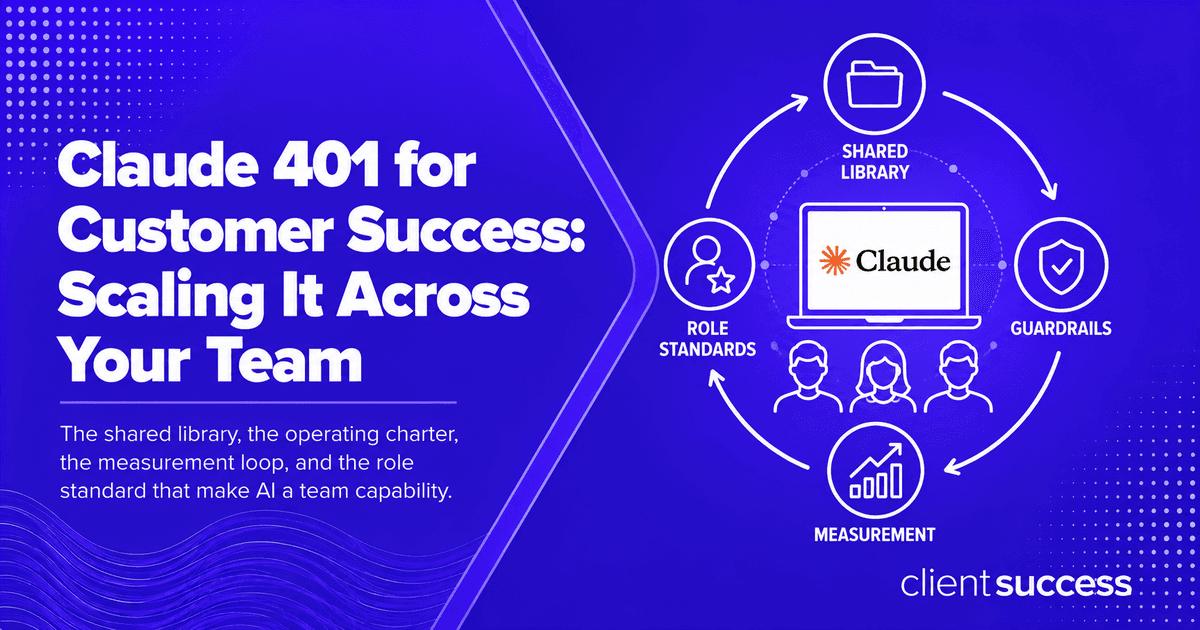
Scaling AI across a CS team takes four layers, built in this order: a shared library, written guardrails, a measurement loop, and a role standard. The order matters. Skip the library and every CSM still starts from a blank page, and a rollout that leaves people at a blank page is a rollout that stalls.
The CS AI Operating Model
The four layers of a team AI system. Build them in order. Each one assumes the layer beneath it, and skipping the first is the most common reason a rollout stalls.
A shared team Project holding a team context file, a catalog of Skills, and a catalog of automations. A CSM's first day with AI begins from the best build on the team, not a blank prompt box.
One written charter: what customer data is allowed in and on which plan, which connectors are approved and what they expose, what runs automatically versus what a human reviews, and who owns the answer when someone is unsure.
Three instruments, baselined before rollout: hours returned to customer-facing work, adoption of the shared assets, and retention movement in the enabled segment. Activity counts are not on the list.
Fluency written into onboarding, into what great looks like, and into the teach-forward rotation. New CSMs arrive into the expectation instead of being converted to it later.
Layer 1: build the shared library
This is the layer that breaks the wall, and it is mostly a copy job. Take what your power user built, strip out what is personal to her, and promote the rest into a team Project that everyone can open.
The centerpiece is a team context file: the version of her context file that describes your company, your product, your health model, and your renewal motion, rather than her book. Individual CSMs still keep a personal file for their own accounts and voice, but they inherit all of the shared truth instead of retyping it.
---
name: team-context
owner: <name>, CS Ops
review_cadence: quarterly
---

# Team Context: Customer Success at <Company>

## Who we are
What we sell, who buys it, the outcome customers hire us for,
and the three or four words we use for it internally.

## How we talk
Our voice with customers: plain, specific, no hype. Words we use
(partner, outcome, adoption). Words we never use.

## Our health model
What a healthy account looks like, the signals that make up the
health score, and what each risk level means in practice.

## Our renewal motion
The stages, the timeline before renewal date, who is involved at
each step, and what "at risk" triggers.

## Our segments
Enterprise / mid-market / scaled: coverage model, expected touch
cadence, and what success looks like in each.

## Standing rules for every output
- Never invent a number. Every figure traces to connected data.
- Mark inferences as inferences.
- Flag anything ambiguous for human review instead of guessing.
- Match the voice above for anything customer-facing.
Alongside it, keep two plain lists. A Skill catalog: the name of each shared Skill, the job it does, who owns it, and the last time it was reviewed. And an automation catalog: the same for anything running on a schedule or trigger, plus whether it is read-only or draft-only. Both can be a table in a shared doc. The point is that a CSM can see what already exists before building a duplicate, and that every shared asset has a name attached to it.
A team capability that depends on one enthusiast is not a capability. It is a single point of failure that happens to be productive.
Layer 2: write the operating charter
At one user, the data question is a judgment call. At a dozen, it has to be a document, or you get twelve different answers and one bad one. The charter is short on purpose. One page that a new CSM can read in three minutes and then act confidently inside.
# CS AI Operating Charter

**Owner:** <name>  ·  **Last reviewed:** <date>  ·  **Next review:** <date>

## 1. What data is allowed
- Approved: customer data inside our business plan, in these systems: <list>.
- Not approved: <list, e.g. contract terms, security questionnaires,
  anything covered by a customer DPA restriction>.
- When unsure: ask the owner above before pasting. Never guess.

## 2. Approved connectors
| Connector | What it exposes | Approved for | Owner |
|---|---|---|---|
| CRM | Accounts, contacts, opportunities | All CSMs | |
| CS platform | Health, usage, tasks | All CSMs | |
| Support | Tickets, conversations | All CSMs | |

Anything not on this list requires review before use.

## 3. What can run on its own
- Runs automatically: read-only and internal work. Digests, monitors,
  internal briefs, risk flags.
- Waits for a human: anything a customer will see. AI drafts it,
  a person reviews and sends. Always.
- Low confidence escalates. An automation flags a thin or ambiguous
  case for review rather than filling the gap with a guess.

## 4. Shared assets
- Team Project: <link>
- Team context file: <link>  ·  Skill catalog: <link>
- New shared Skills are reviewed by the owner before they enter
  the library.

## 5. Review
This charter is reviewed quarterly, and whenever a new connector
or automation is proposed.
Clear the specifics with your security and legal partners before you circulate it, the same step you took at level 101, only now it applies to a team instead of a person. Done well, this document is the opposite of a blocker. It is the thing that lets a CSM build something on a Tuesday without asking permission or worrying she has crossed a line. One thing that makes the connectors section easier to fill in: a connector that publishes its data scope, as the ClientSuccess MCP server does, gives you something concrete to write down instead of a guess.
When automations become a system
There is a genuine capability jump at this level that has nothing to do with policy. Once several automations exist across a team, they can start handing off to each other, and the output becomes something no single CSM could produce by hand.
A book-triage agent ranks where the week should go. A risk monitor watches for the signals that change that ranking mid-week. A renewal-prep assembler takes the accounts the first two flagged and builds the briefs. Each piece is a workflow from level 301. What is new is that the output of one becomes the input of the next, and the leader sees the whole book at once rather than twelve separate views of it.
Two rules keep this from becoming a machine nobody trusts. First, every handoff carries its evidence, so a claim made in the first step is still traceable in the last one. Second, the review line from the charter holds all the way through: a chain of five automations that ends in a customer-facing message still stops at a human. Chained automations are also where a small policy mistake compounds fastest, which is the practical argument for writing the charter before you build the chain, not after.
Layer 3: measure it before you scale it
The trap here is measuring activity. Prompts sent, seats active, tools logged into. None of it tells you whether a single customer was better served, and none of it survives contact with a CFO. Measure three things instead, and capture a baseline before the rollout so you have something to compare against.
- Hours returned. Time per CSM per week moved off assembling and drafting and back onto customers. Ask for a rough self-report before rollout and again at 60 days. Imprecise is fine, directional is the point.
- Asset adoption. The share of the team that runs the shared Skills and starts from the team Project rather than a blank page. This is your truest read on whether fluency is spreading or concentrating.
- Retention movement. Over a couple of quarters, gross and net revenue retention in the enabled segment against a comparable baseline. This is the number that converts an experiment into a budget line.
You will not have the third number early, and pretending otherwise costs you credibility. Lead with hours returned and asset adoption, which move within weeks, and let the retention story build. Say plainly which of the three is a leading indicator and which is the outcome, and leadership will give you the runway.
Layer 4: make fluency the standard
The last layer is the cheapest and the most often skipped. Until AI fluency is part of what it means to be a CSM on your team, it competes with real work and loses.
Three places to write it down. In onboarding, so a new CSM is opening the team Project in week one instead of discovering it in month six. In what great looks like, so the expectation shows up in 1:1s and reviews as a normal part of the craft, not a special initiative. And in a teach-forward rotation, where whoever just learned something teaches the next group, which is both the cheapest enablement you will ever run and the fastest way to find out who actually understands it. The structured version of that program is coming next in this series.
What an AI-first CS team actually looks like
The reason to do all of this is not a faster team. Faster is what you got at 201 and 301. The change at 401 is structural. An AI-first CS team is one where AI is the default starting point for recurring work rather than one person's shortcut, which means the shared assets, the guardrails, and the measurement exist before the work does. That change shows up in three places.
Coverage changes. Accounts that never justified a human touch can get a real one, because the assembling work that made them uneconomical is now automated. The line between your managed and scaled segments moves, and it moves in the direction of more customers getting more attention.
The role changes. When the gathering, drafting, and monitoring are handled, what is left of the CSM job is the part that was always the actual job: judgment, relationships, and the difficult conversation. Hiring and ramp change to match, because you are now hiring for judgment rather than for capacity to assemble.
The plan changes. With shared assets, guardrails, and a measurement loop in place, AI stops being a set of individual experiments and becomes something you can put in an operating plan with a number next to it. That is the difference between a team that uses AI and a team whose strategy accounts for it.
None of this arrives in a quarter, and any leader promising that is selling something. But the sequence is reliable: share the assets, write the guardrails, instrument it, make it expected. The transformation follows the plumbing.
Where this sits on the path
Level 401 assumes the foundations from level 101, the builds from level 201, and the automations from level 301. It is the top of the ladder, and the point where the work becomes a leader's job rather than an individual's. Two companions to this level are coming next in this series: a maturity model for placing your team honestly against these four layers, and a 90-day program for moving a cohort up them. For the whole map, start with the CS Leader's Guide to Mastering Claude.
Your move
- Promote one person's context file into a team context file this week. Copy the skeleton above, strip the personal, and put it in a shared Project. This single move does more to break the individual-to-team wall than any training session.
- Write the charter before you invite the team in. One page, cleared with security and legal, covering allowed data, approved connectors, and the automatic-versus-review line. It takes an afternoon and it prevents the twelve different answers problem.
- Capture your baseline now. Get a rough read on hours spent assembling and on who is using what, before the rollout. Without a before, you will have an interesting story and no number.
- Running a training session instead of building a library. People leave inspired and still start from a blank page on Monday.
- Scaling before writing the guardrails. At one user the data question is a judgment call; at a dozen it is twelve different answers and one bad one.
- Measuring activity. Prompts sent and seats active say nothing about customers; hours returned, asset adoption, and retention do.
- Skipping the baseline. Without a before-and-after you cannot defend the investment, and the enablement stays a side project.
- Leaving fluency as extra credit. Until it is in onboarding and in what great looks like, it loses to the renewal due Friday.
- Letting the champion own it forever. If one person holds the whole system up, you have a single point of failure, not a team capability.
Frequently asked questions
How do you scale AI across a customer success team?
Why does AI fluency stay stuck with one or two people on a CS team?
What is a team context file and why does a CS team need one?
What should an AI governance policy for a CS team cover?
How do you measure the impact of AI on a customer success team?
How long does it take to scale AI across a CS team?
What is an AI-first customer success team?
See how ClientSuccess scales the playbook you've built.
Walk through it with a CS-led demo and see how it'd fit your team.