
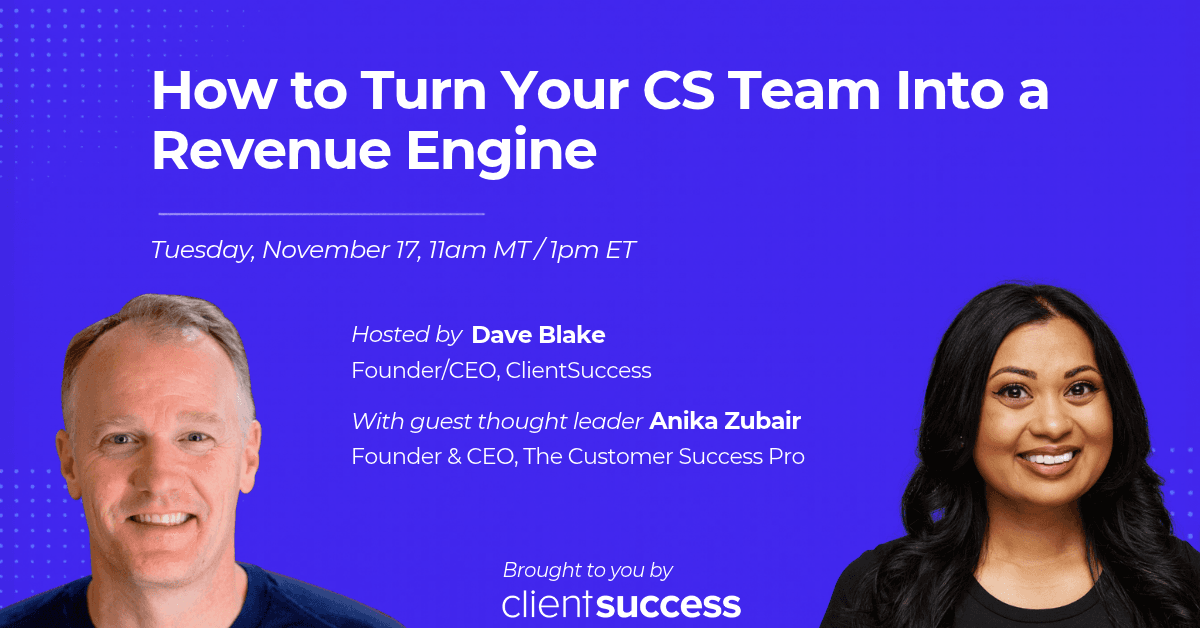
How to Turn Your CS Team Into a Revenue Engine
Your team was told it owns retention and expansion. The meetings, the dashboards and the comp plans did not change. This session is about the four operating changes that close that gap.
Somewhere in the last two years, your customer success team was told it owns revenue. Retention, expansion, maybe the renewal forecast. The slide went up at a kickoff, the job descriptions were rewritten, and the team nodded.
Then Monday came, and nothing underneath it changed. The same weekly meeting, running the same account list in the same order. The same health score dashboard nobody has questioned in a year. The same comp plan, with the same small variable component tied to the same soft goals. A revenue mandate was placed on top of an operating model that was built for something else entirely.
What is a customer success revenue engine?
A customer success revenue engine is a CS team whose operating model, not just its job description, is built to produce retention and expansion revenue: a cadence that surfaces commercial risk early, a signal layer that supports a forecast a CFO will accept, CSMs who sit inside the commercial conversation, and compensation that pays for the outcome the team is held to.
The distinction matters because the first half is cheap and the second half is not. Renaming the function takes an afternoon. Rewiring how it works takes a quarter, and most companies have done the first and called it done.
How wide is the gap between the label and the engine?
Median variable compensation for customer success sits at 20% of total pay, and at 10% when CS is booked into cost of delivery. Only 5% of companies pay CS a variable split of 40% or more, while most sales reps run on 50/50 (CJ Gustafson, Mostly Metrics, 132 tech companies, January 2026).
Read that next to the other half of the same survey: 56% of CS teams are paid on expansion revenue in some form. So a majority of teams carry expansion in their comp plan, and almost none of them carry it at a weight that would change a CSM's behaviour on a Tuesday afternoon. The incentive is present but not material, which is the precise condition under which people keep doing what they did before.
The hiring data points the same direction. Across 658 live customer success listings, 23.6% carried an explicit revenue ownership signal, an NRR target, an upsell mandate or a quota. Only 2.1% carried an actual quota, and most of the revenue-owning roles came with no commission plan, no territory and no pipeline structure (The CS Cafe, September 2026, one job board, directional rather than definitive).
The label moves faster than the machinery. That gap is where most CS revenue mandates quietly die.
What are the 4 Rs?
Anika Zubair's four-part audit for a team that has been given a revenue label. Each R is an operating system question, not a mindset question.
What your team meets about, in what order, and how early. Most CS cadences review accounts alphabetically or by renewal date, which surfaces commercial risk roughly one quarter after it was actionable.
What you watch, and whether it holds up as a forecast. A health score that nobody has recalibrated against actual renewal outcomes is a dashboard, not a radar, and it cannot carry a number you have to defend.
Whether your CSMs are in the commercial conversation or routed around it. Teams that own expansion on paper and hand every pricing discussion to an AE do not own expansion.
What the comp plan actually pays for. If the revenue outcome is 10% of variable pay and variable pay is 20% of total pay, the team is being asked to change its behaviour for 2% of its compensation.
Anika's argument is that these are sequential more often than people expect. Fixing Reward first, which is where most leaders want to start because it feels decisive, usually produces a team that is paid more to do work it still has no rhythm, signal or standing to do.
What you'll learn
- Name the gap honestly. Separate what your team has been told it owns from what its operating model is actually built to produce.
- Walk the 4 Rs. Rhythm, Radar, Room and Reward, with the failure mode and the fix for each.
- Rebuild the forecast. What has to be true about your signals before a renewal number survives contact with a CFO.
- Get into the room. How to put CSMs into commercial conversations without turning them into quota-carrying reps.
- Run the 20 minute audit. Score your own team on each R, pick the single weakest one, and leave with one gap to close this quarter.
Who should attend?
This is built for the leader who already has the mandate and is working out what to do with it: VPs and Directors of Customer Success, Chief Customer Officers, and the CS Ops and RevOps leaders who own the renewal forecast. If your board deck says CS owns NRR and your weekly team meeting looks the way it looked two years ago, this session is about that distance.
Dave Blake, Founder and CEO of ClientSuccess, hosts. Anika Zubair, Founder and CEO of The Customer Success Pro, joins as guest. Anika has spent over 14 years in fast-growing B2B SaaS and has trained more than 5,000 CS professionals across EMEA, the US and APAC. The last ten minutes are moderated live Q&A.
For background on the measurement side of this problem, read Stop Measuring AI Adoption, Start Measuring AI ROI. If you want to pressure-test the Radar layer before the session, the customer health score calculator is a useful starting point.
Speakers
Frequently asked questions
What is a customer success revenue engine?
What are the 4 Rs of customer success revenue?
Why does giving CS a revenue target usually fail?
What is the 20 minute CS revenue audit?
Will the webinar be recorded?
Who should attend this webinar?
Can my whole team attend?
Is there live Q&A?
See how ClientSuccess scales the playbook you've built.
Walk through it with a CS-led demo and see how it'd fit your team.