
The Evolution of Customer Success: From Reactive Support to AI-Driven Strategy
How customer success evolved from a reactive support function to an AI-powered revenue engine — and what comes next.
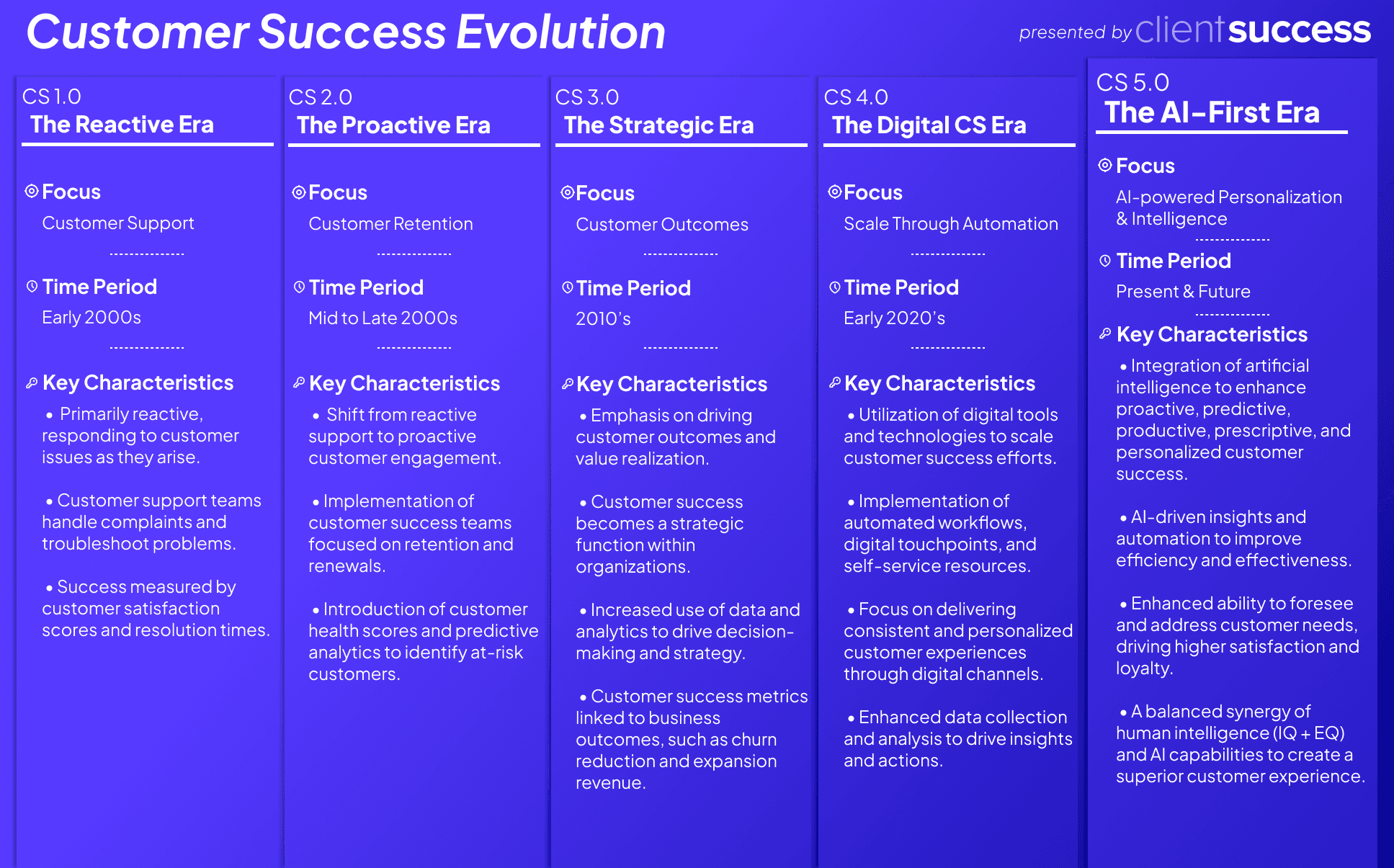
TL;DR
- Customer success has evolved through five eras: CS 1.0 reactive support (early 2000s), CS 2.0 proactive retention (mid-to-late 2000s), CS 3.0 strategic outcomes (2010s), CS 4.0 digital scaling through automation (early 2020s), and CS 5.0 the AI-first era (present and future).
- The shift from reactive to proactive was driven by the realization that retaining existing customers is more cost-effective than acquiring new ones.
- The AI-First Era integrates human intelligence (IQ), emotional intelligence (EQ), and artificial intelligence (AI) so technology augments human capabilities rather than replacing them.
Customer Success Management (CSM) has undergone a remarkable evolution, driven by the changing needs of businesses and their customers. From its early days as a reactive support function to its current role as a strategic, AI-powered discipline, CSM has continually adapted to meet the demands of an increasingly complex business environment. Understanding this evolution is crucial for businesses aiming to stay ahead of the curve and deliver exceptional customer experiences. This article takes you on a journey through the historical milestones of customer success management, exploring how it has transformed from a reactive support role to a proactive, strategic, and AI-driven function.
Customer Success 1.0: The Reactive Era
Time Period: Early 2000s
Focus: Customer Support
In the early 2000s, Customer Success was primarily seen as a reactive function, focusing on addressing customer issues as they arose. This era can be characterized by the emergence of dedicated customer support teams whose main objective was to resolve complaints and troubleshoot problems.
Key Characteristics:
- Reactive Approach: Customer Success was heavily centered around reacting to customer issues. The goal was to solve problems as they came up, rather than preventing them.
- Customer Support Teams: These teams were the frontline, handling a wide array of customer complaints and inquiries.
- Measurement Metrics: Success during this period was measured by customer satisfaction scores and the time taken to resolve issues. Quick and efficient problem resolution was the primary metric for determining success.
This era laid the foundation for what would become a much more proactive and strategic approach to customer success. However, it was clear that a purely reactive strategy was not sufficient to maintain customer loyalty and satisfaction in the long term.
Customer Success 2.0: The Proactive Era
Time Period: Mid to Late 2000s
Focus: Customer Retention
As businesses began to recognize the limitations of a reactive approach, the mid to late 2000s marked a shift towards a more proactive stance in customer success. This era saw the formalization of customer success teams focused on customer retention and renewals.
Key Characteristics:
- Proactive Engagement: Companies started to engage with customers before issues arose, aiming to prevent problems rather than just reacting to them. This shift was driven by the realization that retaining existing customers was more cost-effective than acquiring new ones.
- Customer Success Teams: The creation of specialized customer success teams highlighted the importance of retaining customers and ensuring they achieved the value they expected from the product or service.
- Predictive Analytics: The introduction of customer health scores and predictive analytics allowed companies to identify at-risk customers before they churned, enabling more targeted and effective retention strategies.
The proactive approach of Customer Success 2.0 significantly improved customer retention rates and laid the groundwork for the strategic role customer success would play in the following decade.
Customer Success 3.0: The Strategic Era
Time Period: 2010s
Focus: Customer Outcomes
As customer success continued to evolve, the 2010s marked a pivotal shift from a focus on retention to a focus on customer outcomes. This era recognized that it wasn't enough to simply retain customers; businesses needed to ensure that customers were realizing the full value of the products and services they were using.
Key Characteristics:
- Outcome-Driven Approach: The emphasis moved from merely keeping customers to driving tangible results and outcomes for them. Customer success teams began to align their efforts more closely with the customer’s business objectives.
- Strategic Function: Customer success transitioned from a supporting role to a strategic function within organizations. It became an integral part of the business strategy, with direct influence on product development, marketing, and sales.
- Data and Analytics: The use of data and analytics became increasingly sophisticated, allowing customer success teams to make more informed decisions. Metrics such as churn reduction, customer lifetime value, and expansion revenue became key indicators of success.
- Cross-Functional Collaboration: Customer success teams began to collaborate more closely with other departments, such as product, marketing, and sales, to ensure a cohesive strategy that aligned with the broader business goals.
This era solidified customer success as a critical component of business strategy, emphasizing the importance of delivering outcomes that drive customer satisfaction, loyalty, and long-term revenue growth.
Customer Success 4.0: The Digital Customer Success Era
Time Period: Early 2020s
Focus: Scaling through Automation
The early 2020s brought about the Digital Customer Success Era, driven by the need to scale customer success efforts efficiently and effectively. With the proliferation of digital tools and technologies, companies could now reach more customers with personalized experiences without proportionally increasing costs.
Key Characteristics:
- Digital Tools and Technologies: The adoption of digital tools enabled customer success teams to scale their efforts. This included automated workflows, digital touchpoints, and self-service resources that allowed customers to find solutions independently.
- Consistent and Personalized Experiences: Despite the automation, the focus remained on delivering consistent and personalized customer experiences. This was achieved through digital channels, ensuring that each customer felt valued and supported.
- Enhanced Data Collection: The use of digital tools also enhanced data collection, allowing for more precise customer insights. This data was then used to drive actions and improvements in customer success strategies.
The Digital Customer Success Era marked a significant leap forward in how companies could manage and nurture customer relationships, enabling them to serve a growing customer base while maintaining high levels of satisfaction and engagement.
Customer Success 5.0: The AI-First Era
xAI.png)
Time Period: Present and Future
Focus: Intelligent and Integrated Customer Success
We are now in the midst of the AI-First Era, where artificial intelligence plays a central role in driving customer success. This era is characterized by the integration of AI into every aspect of customer success, from predictive analytics to personalized experiences.
Key Characteristics:
- AI-Driven Insights: AI provides deep insights into customer behavior, preferences, and needs, allowing companies to be more proactive and predictive in their customer success efforts.
- Automation and Efficiency: AI-powered automation streamlines many of the routine tasks in customer success, freeing up human agents to focus on more complex and strategic activities. This improves both efficiency and effectiveness.
- Personalization at Scale: AI enables personalized customer experiences at scale, ensuring that each customer interaction is relevant and meaningful, regardless of the size of the customer base.
- Synergy of IQ, EQ, and AI: The AI-First Era is marked by the integration of human intelligence (IQ), emotional intelligence (EQ), and artificial intelligence (AI). This synergy creates a superior customer experience, where technology augments human capabilities rather than replacing them.
As we look to the future, the AI-First Era promises to further transform customer success, driving higher levels of customer satisfaction, loyalty, and business growth.
Conclusion
The evolution of Customer Success Management reflects the changing dynamics of business and customer relationships over the past two decades. From its origins as a reactive support function in the early 2000s, Customer Success has grown into a strategic, data-driven discipline that is now essential to achieving business success.
The journey through Customer Success 1.0 to 5.0 shows how businesses have continually adapted to better meet customer needs, moving from reactive support to proactive engagement, strategic alignment, digital scaling, and now, AI-powered customer success. Each era brought new tools, strategies, and mindsets that not only improved customer outcomes but also transformed the way companies operate.
As we stand at the forefront of the AI-First Era, the future of Customer Success looks brighter than ever. AI promises to enhance every aspect of customer success, from automation and efficiency to deep insights and personalized experiences. By embracing this new era, businesses can deliver exceptional value to their customers, driving loyalty, retention, and growth.
The historical milestones of Customer Success Management serve as a roadmap for businesses aiming to navigate the complexities of customer relationships in the modern world. By understanding where we've been, we can better chart the course for where we're going, ensuring that customer success remains at the heart of business strategy for years to come.
FAQs
- How has Customer Success evolved over time? - Customer Success has evolved from a reactive support function to a strategic, data-driven discipline that leverages AI to drive personalized customer experiences and business outcomes.
- What is the focus of the AI-First Era in Customer Success? - The AI-First Era focuses on integrating artificial intelligence to enhance proactive, predictive, and personalized customer success efforts, enabling businesses to better meet customer needs and drive growth.
- Why is emotional intelligence (EQ) important in Customer Success? - Emotional intelligence is crucial for understanding customer needs, building strong relationships, and providing personalized support, which are all key to successful customer interactions.
- How can businesses prepare for the future of Customer Success? - Businesses can prepare by embracing AI technologies, integrating data and analytics into their customer success strategies, and fostering a synergy between human intelligence and AI capabilities to deliver superior customer experiences.



Frequently Asked Questions
How has customer success evolved over time?
What are the five eras of customer success?
What defines the AI-First Era of customer success?
See how ClientSuccess scales the playbook you've built.
Walk through it with a CS-led demo and see how it'd fit your team.