
Results-Based Customer Success
Every CS team agrees results matter; almost none can define a customer result. Learn the definition, the Customer Results Ladder, and the results-based motion.
TL;DR
- A customer result is a measurable outcome that is attributable to your product, visible to the customer, and valuable enough that the customer would describe it that way themselves.
- Most CS teams confuse activity, adoption, and outcomes with results, but only a measurable result predicts renewal.
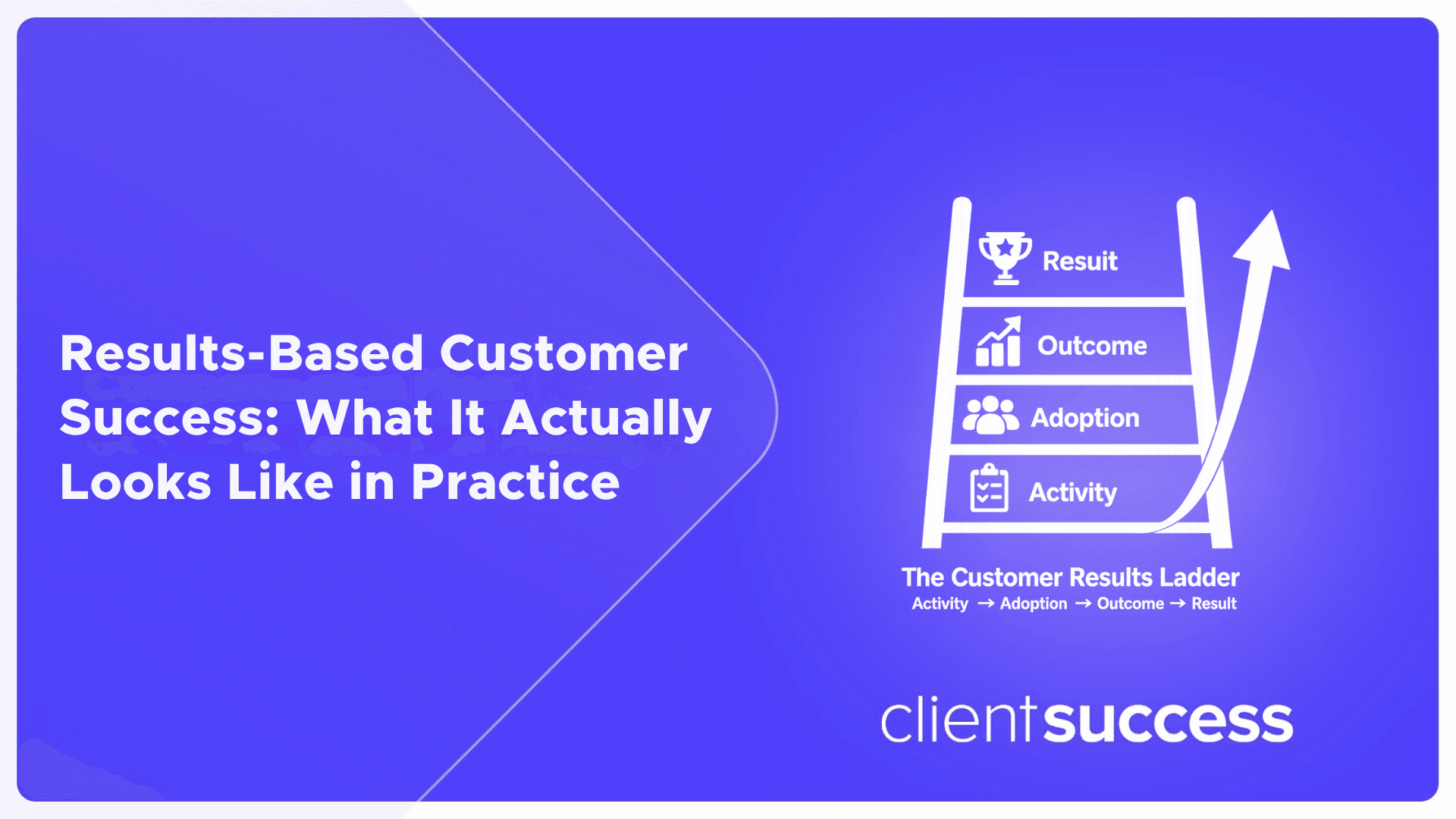
- The Customer Results Ladder gives CS teams a shared vocabulary with four rungs: Activity, Adoption, Outcome, and Measurable Result.
- You don't need perfect analytics to start — only a result definition per segment, a named owner per account, and a 90-day check on whether the customer can name the result they've gotten.
Customer Success Retention CSM Productivity May 12, 2026 · 8 min read
📊 The Operational Definition
Results-Based Customer Success: What It Actually Looks Like in Practice
Every CS team agrees they should measure customer results. Almost none can define what one is. Here's what changes when you do.
TL;DR
The shortest version
- A customer result is a measurable outcome — attributable to your product, visible to the customer, and valuable enough that the customer would describe it that way themselves.
- Most CS teams confuse activity, adoption, and outcomes with results. They aren't the same — and only one of them predicts renewal.
- The Customer Results Ladder gives CS teams a shared vocabulary: Activity → Adoption → Outcome → Measurable Result.
- You don't need perfect analytics to start. You need a definition, an owner per account, and a 90-day check.
Ask ten customer success leaders whether their team is "results-based" and ten of them will say yes. Ask the same ten leaders to define what a customer result is, and you'll get ten different answers — most of which describe activity, adoption, or sentiment instead.
That gap is the whole problem. You can't build a CS motion around something you can't define. So before anything else, here's the definition we'll use throughout this post:
A customer result is a measurable outcome — attributable to your product, visible to the customer, that the customer themselves would describe as valuable.
Three words in that definition are doing the work. Measurable means there's a number, a status change, or a before-and-after the customer can point to. Attributable means your product is a clear cause, not an incidental presence. Visible means the customer can see it without you having to convince them.
If your "result" fails any of those three tests, it isn't a result — it's a story you're telling about the account.
Activity vs. outcome vs. result
The reason "results" gets fuzzy in practice is that CS teams routinely treat three different things as the same thing. They aren't. Here's the distinction in concrete terms:
Type What it describes Example (analytics tool)
Activity Something happened in the product. A click, a login, a configuration. "The team ran a report this week."
Adoption The activity is repeating across users and over time. It's becoming a habit. "Five users on the team are running reports weekly."
Outcome Something is different in the customer's world because of the adoption. "The team is finishing reporting two days faster than before."
Result The outcome is measured, attributed to your product, and described as valuable by the customer. "We cut reporting time 40% — that's why we renewed."
Most CS dashboards top out at adoption. Some get to outcome. Almost none get to result — and that's the gap that quietly destroys retention.
The Customer Results Ladder
The table above isn't just a comparison — it's a framework. We call it the Customer Results Ladder: a four-rung progression every customer climbs (or fails to climb) inside your product.
The Customer Results Ladder is a diagnostic. Every account on your book sits at one of these four rungs, and your job as a CS team is to know which rung — and what it takes to move them up.
Rung 1 — Activity
The customer is using the product. Logins are happening. Features are being touched. This is the lowest bar of life — useful as an early signal that onboarding wasn't completely abandoned, but it predicts nothing about renewal on its own.
Rung 2 — Adoption
Activity is repeating across users and across weeks. There's a pattern. The product is becoming part of how the team works. This is where most CS tooling stops, and where most CS teams declare an account "healthy."
Rung 3 — Outcome
Adoption is producing something different in the customer's environment. A process is faster. A number is moving. A problem they used to have is no longer happening. Outcomes are real — but if you're the only one who knows about them, they don't count yet.
Rung 4 — Measurable Result
The outcome is named, quantified, attributed to your product, and the customer would tell their CFO about it without prompting. This is the rung where renewal stops being a question and expansion becomes a conversation.
The trap most CS teams fall into is treating Rung 2 as the destination. Adoption feels like success. The dashboard is green. But adoption without an attributable outcome is just usage — and usage doesn't renew at premium NRR. Completion is internal. Value is external.
In our work with B2B SaaS CS teams, accounts that can name a specific, measurable result at the 90-day mark renew at roughly 3× the rate of accounts that can't — even when usage metrics look identical.
Defining a result by segment
Results don't look the same across customer segments. The same product can deliver wildly different forms of value depending on who's buying it and why. Forcing a single definition across your whole book is a common mistake — and it usually means SMB results get over-defined and Enterprise results get under-defined.
Here's a starting frame:
Segment What a "result" typically looks like Who validates it
SMB A single, immediate operational win — time saved, error rate dropped, a manual process eliminated. The buyer (often the same person who uses the product).
Mid-Market A team-level outcome — throughput, accuracy, cycle time — visible to the team lead and reportable upward. The team lead + their manager.
Enterprise A business metric tied to the original purchase reason — revenue, cost, risk, compliance — that an executive would defend. An executive sponsor (not the day-to-day user).
The validator column matters more than people think. A result that isn't validated by the right person doesn't survive a renewal conversation. SMB results survive a buyer conversation; Enterprise results have to survive an exec conversation. If you've defined your result at the user level but the renewal is happening at the exec level, the gap will eat you.
What a results-based CS motion looks like
Once "results" is defined, the day-to-day motion changes. Not philosophically — operationally. The differences show up everywhere CSMs actually spend their time:
CS activity Relationship-based motion Results-based motion
QBR Recap of activity, training delivered, support tickets closed. Named results delivered, named results still in flight, plan for the next one.
Health score Weighted on engagement, sentiment, and product activity. Anchored on whether the account has a named, measurable result in the last 90 days.
Renewal conversation "It's been a great year together — let's talk about next year." "Here are the results we delivered. Here's what's next. Here's why expansion makes sense."
Expansion Driven by sales when the relationship "feels right." Driven by results — a measurable win in one team makes the case for another team.
Escalation Triggered by complaints or visible disengagement. Triggered when an account fails to reach a named result inside the expected window.
The relationship-based motion isn't wrong — it just isn't sufficient. The teams that win on retention layer results-based discipline on top of strong relationships. You don't replace one with the other; you stop letting the relationship hide the absence of the result.
The role of product usage data
You can't run a results-based motion without evidence. And the most consistent source of evidence about whether results are happening is product usage data — what the customer is actually doing inside your product, who's doing it, and whether the pattern looks like an account climbing the ladder or stalling on one rung.
Usage data isn't the result itself. It's the supply of evidence that lets CSMs ask the right question at the right time. Without it, "results" becomes a guess.
This is also where most CS teams get blocked: they accept that results matter, they buy the framework, and then they have no way to see whether results are happening across 80 accounts. The motion collapses under its own weight. We covered the structural version of this problem in Health Scores Don't Reduce Churn — Actions Do: visibility without action is just a more expensive dashboard.
The minimum viable version
You do not need perfect analytics to run this. You need a definition, an owner per account, and a check at the right interval. Here's the smallest possible version of the motion:
- Define one result per segment. Write down — literally on one page — what a "result" looks like for SMB, Mid-Market, and Enterprise accounts in your book. Make it specific, measurable, and named by an internal owner. If you can't get to one per segment, get to one per top-tier segment and start there.
- Assign every account a named result. For every account on every CSM's book, the CSM should be able to tell you in one sentence: "The result we're driving for this account is X, and the validator is Y." Accounts without a named result go on a triage list.
- Run a 90-day result check. At the 90-day mark of every customer relationship, the CSM must answer one question on the record: "Can this account name the measurable result they've gotten?" Yes is healthy. No is an intervention trigger, not a status update.
This is a spreadsheet's worth of work for a CS team that's serious about results, and it will reshape the conversation inside your team within a quarter. Tooling makes it scalable. The definition makes it possible at all.
A spreadsheet gets the first quarter done. Past a handful of CSMs, naming a result per account and checking it every 90 days is exactly the kind of thing that gets lost between tools. See how ClientSuccess gives every CSM one place to assign, track, and validate a result per account.
Common mistakes
A few patterns we see repeatedly when CS teams try to move to a results-based motion:
-
Confusing adoption for results. "The customer is using the product" is not a result. It's the precondition for one. Stopping at adoption gives you renewal volatility you can't explain.
-
Letting CSMs define results unilaterally. A result the CSM picked is not the same as a result the customer would validate. If the customer wouldn't say it out loud, it doesn't count.
-
Tracking results without owners. A "result" that isn't owned by a specific person in the customer's organization will not survive turnover, reorg, or the renewal cycle. Name the validator before you name the result.
-
Waiting for perfect data. The minimum viable motion runs on a spreadsheet and a definition. Most CS teams that "can't" move to results-based are actually choosing not to define what one is.
The bottom line
Satisfaction is what the customer feels. A result is what the customer can prove. Only one of those compounds into retention — and it's the one most CS teams aren't measuring yet. For the underlying argument, see The Satisfaction-Results Gap.
CS Leadership Insights New posts and webinar invites — no fluff.
Subscribe
Related Resources


Frequently asked questions
What is a customer result in SaaS?
How is a customer result different from a customer outcome?
What is the Customer Results Ladder?
How do I measure customer results without a product usage analytics tool?
What's the difference between a results-based and relationship-based customer success motion?
Who should own defining customer results — the CSM or the customer?
What are examples of customer results in B2B SaaS?
See how ClientSuccess scales the playbook you've built.
Walk through it with a CS-led demo and see how it'd fit your team.