
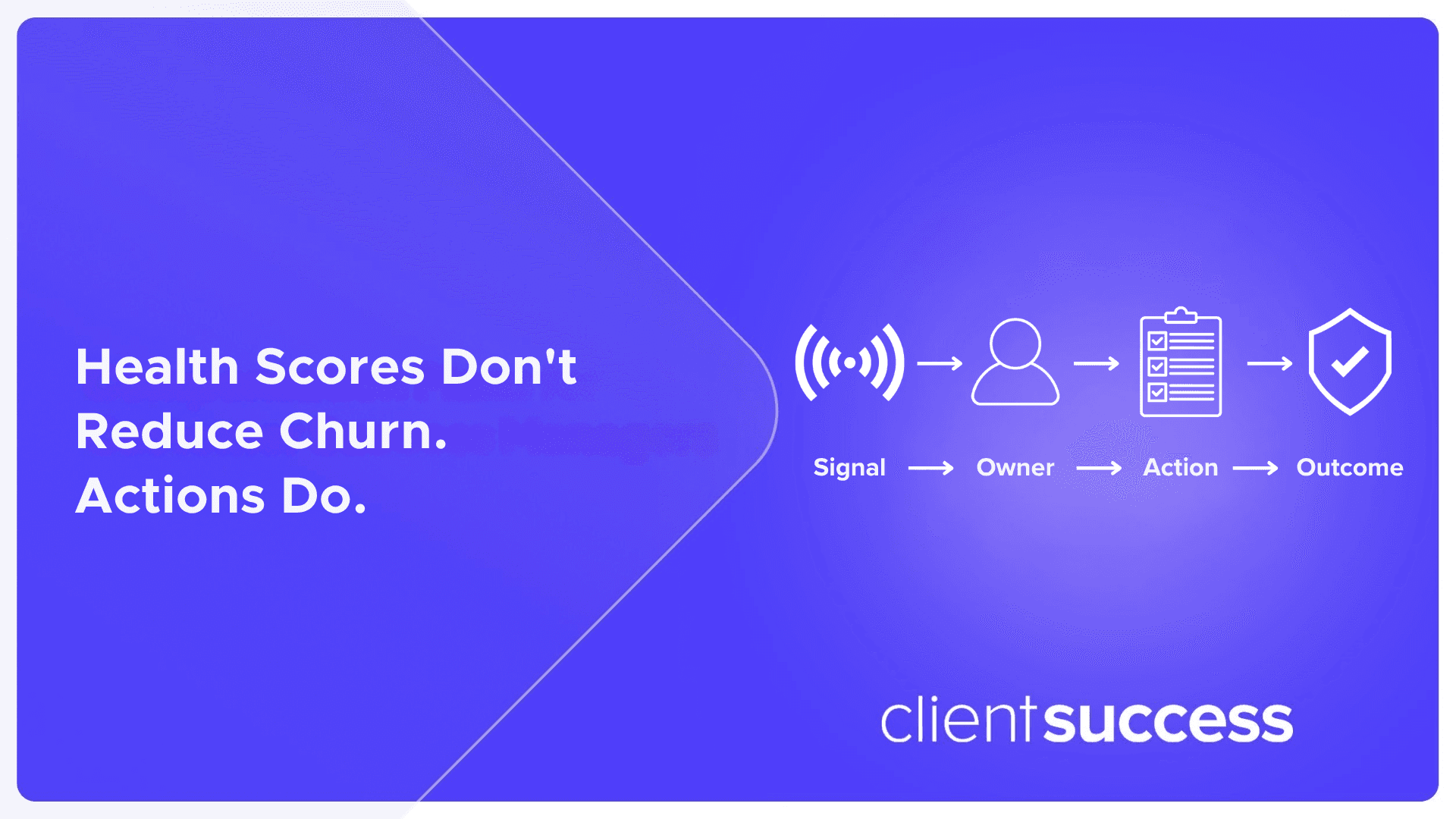
Health Scores Don't Reduce Churn. Actions Do.
Customer health scores tell you who's at risk but don't save anyone. Churn is reduced by the action system that fires after a score drops, not the score.
TL;DR
- Customer health scores don't reduce churn; the actions a team takes when a score changes do. A score only prevents churn when it triggers a specific action, a single owner, and a hard deadline.
- AI is closing the signal-detection gap, which makes the action problem — what your team does when a signal fires — the only real differentiator in customer success.
- Severity must map to behavior: red means act today, yellow means act this week. If color doesn't change what a CSM does, the health program is reporting, not preventing.
- A weekly risk-and-action review must end with owners assigned and interventions scheduled, not notes.
Health Scores Churn Customer Success April 2026 · 7 min read
🚨 The Churn Prevention Gap
Health scores don'treduce churn.Actions do.
AI is making it easier than ever to know which customers are at risk. The problem was never the signal. It was always what your team does next. This post shows how to build a signal → action system that turns detection into intervention — every time.
TL;DR
The short version
- AI is making the signal problem cheaper to solve. The action problem — what your team actually does when a signal fires — is now the only real differentiator in customer success.
- A health score is a trigger, not a solution. It's only useful if it produces a specific action, a single owner, and a deadline.
- Red means act today. Yellow means act this week. If severity doesn't change behavior, your health program is reporting — not preventing.
- If you only do one thing: build a weekly list of accounts past expected Time-to-First-Value, assign owners, and schedule interventions before the meeting ends.
AI solved the signal problem. That makes the action problem the only one that matters.
Customer health scores don't reduce churn. The actions your team takes when a score changes do. A health score is only useful if it immediately triggers a specific action, assigns a single owner, and sets a hard deadline. Without those three things, it's a reporting tool — not a churn prevention system.
For years, the standard critique of health scoring was that the data wasn't good enough. Signals were lagging, coverage was incomplete, and CSMs spent more time debating whether the score was right than actually doing anything about it.
That critique is becoming obsolete. AI is rapidly closing the signal gap — surfacing risk earlier, correlating signals across larger portfolios, and reducing the manual work of knowing which accounts need attention. The tools are getting better fast, and the category is moving with them.
But here's what hasn't changed: most CS teams still don't have a clear decision system for what to do when a signal fires.
The question used to be: "Did we catch it in time?" AI is making that question easier to answer. The harder question — "What do we actually do now, who owns it, and by when?" — is still almost entirely a human operating problem.
That's where health programs still collapse, and it's not a data problem. It's a behavior problem:
- Too many signals, not enough playbooks. Alert volume goes up; response consistency goes down.
- No standard response. "Red" means something different to every CSM on the team.
- No ownership. Everyone sees the risk. Nobody owns the save.
- No deadlines. Accounts drift through "yellow" for weeks until renewal panic arrives.
As we covered in The 30-Day Time-to-Value Sprint, the weekly exec review must end with owners and scheduled actions — not notes. The same discipline applies to your health system at every level. Measurement doesn't reduce churn. Interventions do.
What a health score should actually do
A health score is not the product. It's the trigger.
Think of it like a smoke alarm. The alarm doesn't put out the fire. It's only valuable if there's a system behind it — who calls whom, what they do, and how fast. A smoke alarm in a building with no evacuation plan is just noise.
When a signal changes, your team should immediately be able to answer:
- What specific action does this require?
- Who owns it — one name, not a team?
- What is the deadline?
- What does "done" actually look like?
If your health system can't answer all four consistently, stop improving the score and build the response system first.
"If the score changes but behavior doesn't, nothing changed." A dashboard is not a decision engine.
How do you build a health score system that actually prevents churn?
You don't need a complicated model. You need a repeatable decision flow that every CSM on your team runs the same way, every time. Here's the four-part system:
1. Signal — what changed?
Most teams overbuild here. Thirty signals sounds comprehensive; it produces alert fatigue and inconsistency. Start with 6–8 signals that map directly to churn risk and have a playbook attached. If a signal doesn't trigger a specific action, cut it.
Signal Category Example Triggers
Usage Usage drops meaningfully week over week; key workflow not completed by Day X; active users declining in a core role
Value Onboarding stalled before first value milestone; no measurable progress toward success criteria
Relationship Champion change; negative sentiment or escalation; executive sponsor goes dark
Commercial Renewal window approaching with unresolved risk; expansion conversation stalled
2. Urgency — how fast do we move?
Keep this ruthlessly simple. The moment urgency tiers get complicated, they stop being followed.
- Red: act today — same business day
- Yellow: act this week — within 3–5 business days
- Green: maintain momentum and capture proof of value
The rule that unlocks everything: every severity level must map to a required action with a specific deadline. "Red" is not a status. It's an instruction. If it doesn't change what a CSM does today, the color is theater.
3. Context — is there an obvious explanation?
Before triggering escalations, run a 60-second context check. This single step cuts false alarms significantly and protects CSM time from busywork.
- Is there a known outage or open support incident?
- Is the customer in a planned pause or seasonal slowdown?
- Did implementation timing shift, or is there a customer re-org underway?
If the signal is explained by context, log it and monitor. If it's unexplained, act immediately.
4. Action — what happens next?
This is where health programs fail most often. Plenty of teams can tell you a customer is at risk. Very few have a clear, consistent answer for what happens in the next 24 hours. Every signal path must produce:
- A specific action — not "check in." Schedule a working session. Apply the recovery playbook. Pull in implementation support. Name the move.
- A single owner — one person's name, not "the team" or "CS."
- A hard deadline — same day, 3 business days, 5 business days. Not "soon."
- A definition of done — what must be true for this action to be closed? Blockers documented? Customer confirms next step? Plan shared with leadership?
Red, Yellow, Green: the baseline playbook
Here's a copy-and-adapt starting point. Adjust thresholds to your segment mix, but don't soften the deadlines — that's where most teams negotiate away the discipline that makes the system work.
🔴 Red — act today
Goal: stop the drift and get a real plan in motion. No RED account goes a full week without a scheduled intervention.
Situation Action Owner Deadline Done When
Default RED Working session scheduled with customer CSM Same day Blockers named, revised plan agreed
Technical blocker Escalate to support or implementation Internal owner 24 hours Fix plan and timeline shared with customer
Renewal risk present Leadership alignment and sponsor outreach CS leader 48 hours Revised success plan confirmed, next date set
🟡 Yellow — act this week
Goal: diagnose the risk driver and prevent a slide to Red. Rule: if Yellow doesn't improve by the next weekly review, it automatically escalates to Red.
Action Owner Deadline Done When
Diagnose the risk driver CSM 3 business days Root cause documented, next step scheduled
Apply preventative playbook CSM 5 business days Customer completes next step toward first value milestone
🟢 Green — capture proof and protect momentum
Goal: Green isn't "ignore." It's the window to lock in renewal confidence and build the expansion narrative before the conversation happens.
Action Owner Deadline Done When
Capture a value note CSM 14 days 3 bullets of measurable outcomes ready for QBR or renewal
Expansion readiness check CSM + Sales partner 30 days Expansion signals flagged, timing confirmed
The weekly review that makes all of this stick
A health system without a weekly rhythm degrades fast. CSMs revert to intuition. Ownership gets fuzzy. Red accounts slip through. The cadence is what turns a policy into a practice.
One short meeting, run the same way every week, with one non-negotiable output:
Weekly Risk & Action Review — 10 to 20 minutes
- How many RED accounts?
2. What are the top 2 risk drivers this week?
3. What specific actions are scheduled — and who owns each one?
4. Which accounts have been RED for 2+ consecutive weeks?
The output must be owners assigned, actions scheduled, follow-ups dated. If the meeting ends with notes and good intentions, it didn't happen. This is the same standard the weekly exec review holds for TTFV-at-risk accounts — the discipline is identical.
Why health programs become theater
Most of these failure modes are invisible until you're staring at a surprise churn. Check your program against this list honestly.
- Improving the scoring model instead of improving the response time
- Too many signals with no playbooks — alert volume rises, response rate drops
- "Red" with no required next step attached
- Multiple owners on at-risk accounts, which means no real owner
- No deadlines — severity sits in yellow indefinitely
- Leadership reviews dashboards; CSMs experience chaos
- CSMs don't trust the score, so they substitute their own judgment inconsistently
The bottom line
The goal of a health program isn't visibility. It's behavior change. AI can accelerate how quickly you detect risk. What it can't do is replace the clarity of knowing exactly what your team does next — who acts, how fast, and what "fixed" looks like. Build the decision system first. The technology makes it faster. It doesn't make it unnecessary.
Where AI fits — and what it changes
The CS industry is in the middle of a meaningful shift. AI is getting better at detecting risk earlier, synthesizing account context across large portfolios, and surfacing patterns that would take a CSM hours to find manually. Platforms like ClientSuccess are actively building these capabilities, and the trajectory is significant.
But there's an important distinction between what AI accelerates and what still requires human judgment and operating discipline.
Where AI adds real leverage in a health program:
- Surfacing at-risk accounts earlier — before a CSM notices the signal manually
- Summarizing call and ticket history into concise risk drivers and suggested next steps
- Identifying portfolio-wide patterns: stall loops, repeated blockers, adoption gaps by segment
- Drafting playbook outreach so CSMs spend time on conversations, not copy
- Preparing the weekly risk review summary automatically, so the meeting focuses on decisions
What still requires human ownership:
- Deciding what action to take — AI can recommend, but someone has to commit
- Executive sponsor conversations and stakeholder alignment
- Scope resets, commercial negotiation, and renewal strategy
- Judgment calls where relationship context outweighs the signal data
The same dynamic applies to the 4-Stage Adoption Arc — AI can identify when an account has stalled at Activated and never progressed to Adopted, but the CSM determines whether the right move is a re-engagement playbook, a scope conversation, or an executive call. AI narrows the gap between noticing and acting. The decision system determines what happens once you're there.
The teams that will win retention over the next few years aren't the ones waiting for AI to solve the problem end-to-end. They're the ones building the action system now — so that when the AI capabilities arrive, they have somewhere to route the signal.
See the decision engine in action
ClientSuccess is built to help CS teams move from signal to action — faster, more consistently, and at scale. See how it works for your team.
Related Resources
Frequently asked questions
What is a customer health score and how does it prevent churn?
My health score goes red but customers still churn. What am I missing?
Will AI replace customer health scoring — or make it better?
What signals should I include in a customer health model?
How do I stop my CS team from ignoring health score alerts?
How often should a CS team review customer health scores?
See how ClientSuccess scales the playbook you've built.
Walk through it with a CS-led demo and see how it'd fit your team.