
The Four Stages of Product Adoption
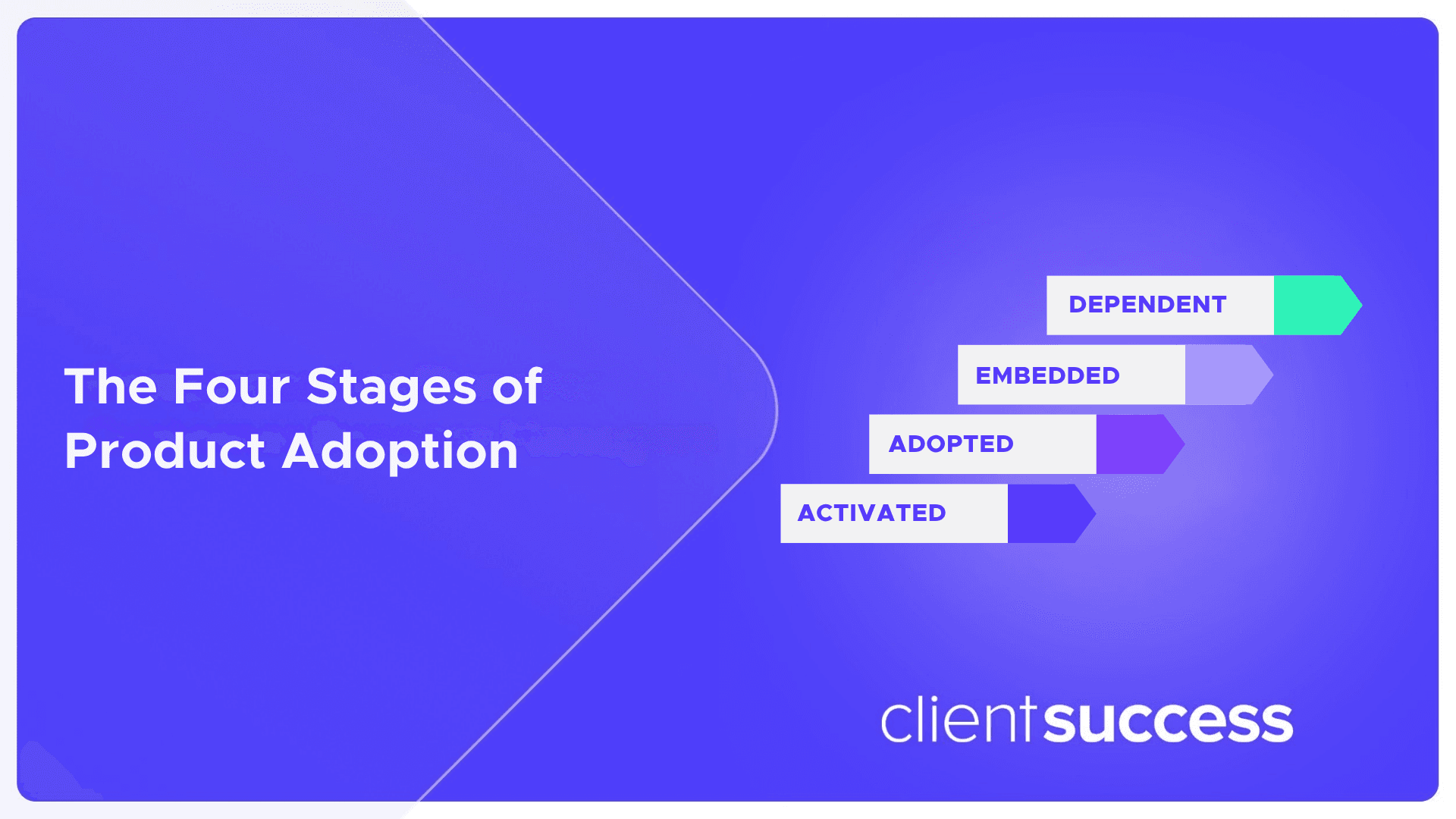
Adoption isn't binary. Learn the four stages — Activated, Adopted, Embedded, Dependent — each customer moves through, and the CS play that moves them forward.
TL;DR
- Adoption isn't binary: customers move through four distinct stages — Activated, Adopted, Embedded, and Dependent — and where a customer stalls determines what they need next.
- Each stage has a different failure mode and a different intervention, which is why a single, stage-blind health score underperforms.
- Stage 2 (Adopted) is make-or-break: customers who don't reach meaningful adoption within 30 days are unlikely to ever get there, so interventions should fire at Day 7, Day 14, and Day 21+.
- Only Stage 4 (Dependent) drives expansion — dependent customers renew, expand, and advocate because operational switching cost, not the contract, keeps them.
Customer Success Product Adoption Retention March 16, 2026 · 8 min read
🔄 The Four Stages of Product Adoption
The Four Stages ofProduct Adoption —and what to do at each one.
Most CS teams treat adoption like a binary: either the customer is using the product or they're not. That mental model is costing you renewals. Adoption is a progression — and where your customer stalls determines exactly what they need next.
TL;DR
The short version
- Adoption isn't binary. Customers move through four distinct stages: Activated, Adopted, Embedded, and Dependent.
- Each stage has a different failure mode — and a different intervention. Treating them all the same is why generic "health score" plays don't work.
- Stage 2 is make-or-break: research consistently shows that customers who don't reach meaningful adoption within 30 days are unlikely to ever get there.
- The goal isn't just retention — it's reaching Stage 4. Dependent customers don't just renew; they expand, refer, and advocate.
Why "adoption" is the wrong unit of measurement
When CSMs talk about adoption, they usually mean product usage — logins, feature activations, seats filled. And while those signals matter, they tell you almost nothing about where a customer is in their journey with your product.
A customer who logged in yesterday might be one week away from canceling. A customer who hasn't logged in for two weeks might be so embedded in your platform that their entire team depends on it. Usage without context is noise.
The better model: adoption is a progression. There are four distinct stages, each with its own retention risk profile and its own set of interventions that actually move the needle.
Behavioral psychology and product adoption research both point to the same pattern: customers don't adopt products all at once. They move through predictable stages — and stalling at any stage dramatically increases churn risk.
The four stages at a glance
Stage 1 Activated First meaningful action taken. Crossed the threshold from signed-up to actually tried it.
Stage 2 Adopted Hit 1–2 signal behaviors. Had the "I get it" moment. Experienced the outcome they bought.
Stage 3 Embedded Behavior is no longer effortful. The product is part of how they work — not something they think about.
Stage 4 Dependent Cannot imagine working without it. Switching is genuinely painful. Expansion is natural.
Let's go deep on each one — what it looks like, where it breaks down, and what your CS team should actually be doing at each stage.
Stage 1: Activated — the hardest gate
Most users never get here. That's the uncomfortable truth about SaaS activation: the majority of customers who sign a contract, complete onboarding, and get access to your product will never take the first meaningful action that signals genuine intent to use it.
Activation is the moment a customer crosses from "set up" to "actually tried it." Not logged in — tried it. Completed the first real workflow. Ran the first report. Loaded their first dataset. The specific behavior varies by product, but the signal is the same: they've done the thing the product is actually for.
What "activated" looks like in practice
-
The first workflow created and run — not just saved
-
The first meaningful data loaded, not just a test record
-
The first stakeholder invited and active — not just you
-
The first integration connected to a live system they actually use
The activation trap: CS teams often conflate "onboarding complete" with "activated." They're not the same. Completion is internal — it measures what your team did. Activation is external — it measures what the customer started. Onboarding complete means your team finished their checklist. Activated means the customer started theirs. We covered this distinction in depth in Onboarding Completion is a Lie — if you haven't read it, start there.
What your team should be focused on at Stage 1
This is where navigation beats reinforcement. Customers at Stage 1 don't need encouragement — they need a clear, frictionless path to the first signal behavior. Every hour spent in training that could have been spent doing is an hour of activation risk.
The CSM's job at Stage 1 is ruthless simplification: what is the single fastest path from "access granted" to "first meaningful use"? That path — and only that path — should dominate the first 7–14 days. We break down exactly how to build and execute that fast path in The 30-Day Time-to-Value Sprint.
If customers are stalling at Stage 1, your activation problem usually isn't engagement — it's clarity. They don't know what the "first win" looks like.
Stage 2: Adopted — the 30-day window
Stage 2 is where the retention equation is won or lost. The research is consistent: customers who don't reach meaningful adoption within 30 days are unlikely to ever get there. The probability of long-term retention drops sharply after the window closes. And here's the part most CS orgs get wrong: measurement doesn't reduce churn. Interventions do. Knowing a customer is at Stage 2 only matters if your team does something about it.
Adopted means the customer has reached 1–2 signal behaviors — the specific actions research has shown correlate with retention in your product. They've had their "I get it" moment. They've experienced the outcome they paid for. They can point to a result.
"If your customer can't point to a result within 30 days, they're not adopted. They're on borrowed time." The belief in the product dies long before the contract ends.
Signal behaviors vs. activity behaviors
Not all product usage is equal. The mistake most CS teams make is treating all activity as adoption signal. It isn't.
Behavior type Examples Predicts retention?
Vanity activity Login, profile completion, clicking through a tour No — doesn't signal value
Engagement activity Feature exploration, viewing dashboards, reading docs Weakly — intent without outcome
Signal behavior First report used in a decision, first workflow saving real time, first outcome measured Yes — proof of value received
The CS team's job at Stage 2 is to define the signal behaviors for each segment and track time-to-signal. Not time-to-login. Not time-to-feature-activation. Time-to-the-thing-that-proves-the-product-is-working. That metric has a name: Time-to-First-Value (TTFV) — and it's the most predictive retention signal you can track at this stage.
Key Takeaway
Define 2–3 signal behaviors per customer segment and build your Stage 2 playbook around reaching them within 30 days. When customers stall, your intervention triggers should fire at Day 7 (quick win nudge), Day 14 (reset the plan), and Day 21+ (recovery + exec sponsor). Build a TTFV-at-risk list and review it weekly. Need a week-by-week system for doing this? The 30-Day Time-to-Value Sprint is the operational playbook.
Stage 3: Embedded — the habit formation stage
Here's what most CS teams miss: there's a vast difference between a customer who uses your product deliberately and one who uses it automatically. Stage 3 is about closing that gap.
Embedded means the behavior is no longer effortful. The customer isn't deciding to use the product — they just use it, the same way they use email or Slack. It's part of their work rhythm. It's in their muscle memory. It's on the agenda without anyone putting it there.
This is the habit formation stage. Behavioral psychology research is clear on how habits form: through cue-routine-reward loops that repeat until the behavior becomes automatic. Your product design and your CS motion both need to serve this process.
The three mechanics that drive Stage 3
- Progress visibility. Customers need to see their own momentum. Dashboards, milestone trackers, and usage summaries aren't vanity features — they're reinforcement loops. When customers can see that they're winning, the behavior that produced the win gets repeated.
- Normative benchmarking. "You're in the top 20% of teams using this workflow" is more motivating than any feature announcement. Comparison to a relevant peer group activates both social proof and competitive instinct. Use it.
- Investment loops. Every piece of value the customer puts into the product — data, configurations, custom views, integrations — increases the perceived cost of leaving. The more they invest, the more embedded they become. Your CS motion should actively encourage this investment, not just track usage.
Warning signs a customer is stuck between Stage 2 and Stage 3
-
They use the product during CSM-led sessions but not independently
-
Adoption spikes before QBRs and drops afterward
-
They know the product works but still describe it as "one more tool to check"
-
New team members aren't getting onboarded into the platform organically
Customers stuck between Stage 2 and Stage 3 are the most dangerous segment in your portfolio. They've seen value — so they don't raise red flags. But the product hasn't become a habit, so they're quietly at risk every renewal cycle.
Stage 4: Dependent — the deepest retention state
Stage 4 is the destination. Not just retained — dependent. The customer cannot imagine going back to how they worked before. The product is woven into their workflow, their team's workflow, and in many cases, their organization's processes.
The key distinction at Stage 4: switching cost is no longer contractual, it's operational. It's not that they'd lose access to a tool — it's that they'd lose the data, the configurations, the institutional knowledge, the team habits, and the outcomes that have accumulated over months or years of use.
"Switching has become genuinely painful — not because of contracts but because of what they'd lose." This is the difference between a customer who stays and a customer who can't imagine leaving.
What Stage 4 looks like in the real world
- Multiple teams are using the platform — not just the original buyer's team
- The product appears in internal docs, onboarding materials, and team SOPs
- New employees are trained on the platform as part of ramp
- Executives reference platform data in leadership meetings
- Expansion is a natural conversation — not a sales play
Stage 4 is the only stage that drives expansion
This is the commercial insight that should reshape how CS leaders think about adoption. Expansion revenue doesn't come from satisfied customers — it comes from dependent ones. Customers expand when the product has proven itself so thoroughly that scaling it is an obvious next step, not a risk.
If your expansion motion relies on selling customers who are still at Stage 2 or 3, you're selling upstream of trust. You'll close some deals — but you'll also create the churn-then-expansion cycle that quietly destroys net revenue retention.
Key Takeaway
Your expansion pipeline is a lagging indicator of your Stage 4 conversion rate. If expansion deals are hard to close, look upstream — your adoption motion isn't getting customers to Embedded and Dependent fast enough.
Building a stage-aware CS motion
The reason most customer success playbooks underperform isn't execution — it's that they're stage-agnostic. They treat a newly activated customer the same way they treat a deeply embedded one. Different stages have different failure modes, and they require different interventions.
Stage Primary CS motion Key signal to watch Churn risk if stuck
Stage 1: Activated Simplify the path to first signal behavior Days to first meaningful action Very high — most churn begins here
Stage 2: Adopted Drive to signal behaviors within 30 days Signal behavior completion rate High — the 30-day window is real
Stage 3: Embedded Reinforce habits; encourage platform investment Independent vs. CSM-led usage ratio Moderate — invisible until renewal
Stage 4: Dependent Expand use cases; develop champions Multi-team usage, exec engagement Low — operational switching cost
What to stop doing immediately
- Using a single health score for all stages. A Stage 2 customer with 70% health needs completely different attention than a Stage 4 customer with 70% health. Stage-blind scoring hides the real picture.
- Running the same QBR agenda for every account. QBRs for Stage 2 customers should be about proving value. QBRs for Stage 4 customers should be about expanding it. Same agenda kills both.
- Measuring feature adoption as a proxy for stage. Features can be activated and never used meaningfully. Stage is about behavioral outcomes, not feature checkboxes.
- Treating Stage 3 customers as "safe." They're not. They've seen value but haven't formed the habit. They'll tell you in a survey they're satisfied — and then not renew because nothing made them feel dependent.
How to tag and track customer stages in your CS platform
You don't need to rebuild your CS tech stack to start operating with stage awareness. You need three things: a definition, a signal, and a field.
- Define the stage criteria for your product. What does "Activated" mean specifically? What are the 1–2 signal behaviors that define "Adopted"? What usage pattern confirms "Embedded"? What multi-team or organizational signals indicate "Dependent"? Write these down. Specificity is the whole game.
- Map the signals you can actually measure today. Don't wait for perfect instrumentation. Most teams can identify 80% of stage transitions with existing CRM properties, product event data, and CSM notes. Start with what you have.
- Add a "Adoption Stage" field to your customer records. Make it a required field on all accounts. CSM-updated weekly or triggered by product events. This single field will reveal more about your renewal forecast than any health score you currently have.
- Build stage-specific playbooks. One playbook per stage. Each with clear trigger criteria, specific actions, defined timelines, and escalation paths. Generic "at-risk" playbooks are better than nothing — but stage-specific playbooks are what actually move customers forward.
- Report on stage distribution, not just health score. What percentage of your book is at each stage? What's the average time-to-Stage-2? How many customers have been at Stage 3 for more than 90 days without moving to Stage 4? Build a TTFV-at-risk list for every Stage 1 and Stage 2 account and run a weekly review — 20 minutes max, must end with owners and scheduled actions, not notes. These are the questions your executive team should be asking every week. For the exact metrics and exec view format, see Onboarding Completion is a Lie and the 30-Day TTV Sprint.
Do This This Week
Pick 10 accounts and manually score them against the four stages. Then ask: are you running the right CS motion for where each one actually is? The gap between your answer and your current playbook is your retention risk.
Ready to See It In Practice?
ClientSuccess helps CS teams track adoption stage across their entire book of business — with stage-specific playbooks, signal behavior tracking, and the reporting your exec team actually needs. See how it works.
Related Resources
Frequently asked questions
How are the four stages of product adoption different from a standard health score?
What if a customer seems to regress from Stage 3 back to Stage 2?
How do you identify signal behaviors for Stage 2 if you don't have strong product analytics?
Is Stage 4 achievable for all customers, or just enterprise?
How often should CSMs update adoption stage in your CS platform?
Do these four adoption stages apply to product-led growth (PLG) motions?
See how ClientSuccess scales the playbook you've built.
Walk through it with a CS-led demo and see how it'd fit your team.