
How to Set Up OKRs and Align them to Customer Success
Learn how to set OKRs and align them to customer success. Use Google's goal-setting method to roll company objectives down to measurable CS team goals.
TL;DR
- OKRs (Objectives and Key Results) are a measurable, actionable goal-setting method that Google has used since 1999, applicable to companies of any size.
- OKRs are meant to be ambitious; if you're certain you'll hit them, you aren't thinking broadly enough, and the process fails unless everyone has visibility into what others are working on.
- For customer success, align department OKRs with company goals and roll them down to teams and individuals, around metrics like issue resolution times, retention, or upsell revenue.
Setting and meeting goals helps you grow and scale your organization. For customer success leaders, these goals are often centered on retaining customers and increasing upsells. To achieve these goals, there are many goal setting methodologies that help to align and engage your teams. Today we are going to discuss the OKR method to goal setting.
Rick Klau, Google Ventures Startup Lab Partner and technology industry veteran, presented a GV Startup Lab presentation on Objectives and Key Results (OKRs) a few years back. OKRs have been a steady secret to Google’s success since 1999. Klau’s presentation, which we’ll share from below, showcases some great insight into getting started with OKRs and their importance to a growing business.
Understanding Objectives & Key Results
As a business leader—especially if you’re part of a smaller or scaling organization—you may look at the OKR goal setting strategy and think, “We are so much smaller than Google. How could this ever apply to us?” Klau actually addressed this setback in the beginning of his talk, when he took a step back to look at the history of OKRs at Google. Google was once a small company, too, and this now multi billion-dollar enterprise has been using OKRs since the very beginning.
What makes OKRs so compelling for decision makers? These types of goals are measurable and actionable. “OKRs give you the ability to qualify and actually quantify goals,” Klau clarified for the GV Startup Lab audience. He used a real-world example on his slide, of a Google project manager who stated his OKR was, “To launch a new product—Gmail—in September and have one million users by November.” These types of goals may seem lofty—and that’s the true root concept of OKRs.
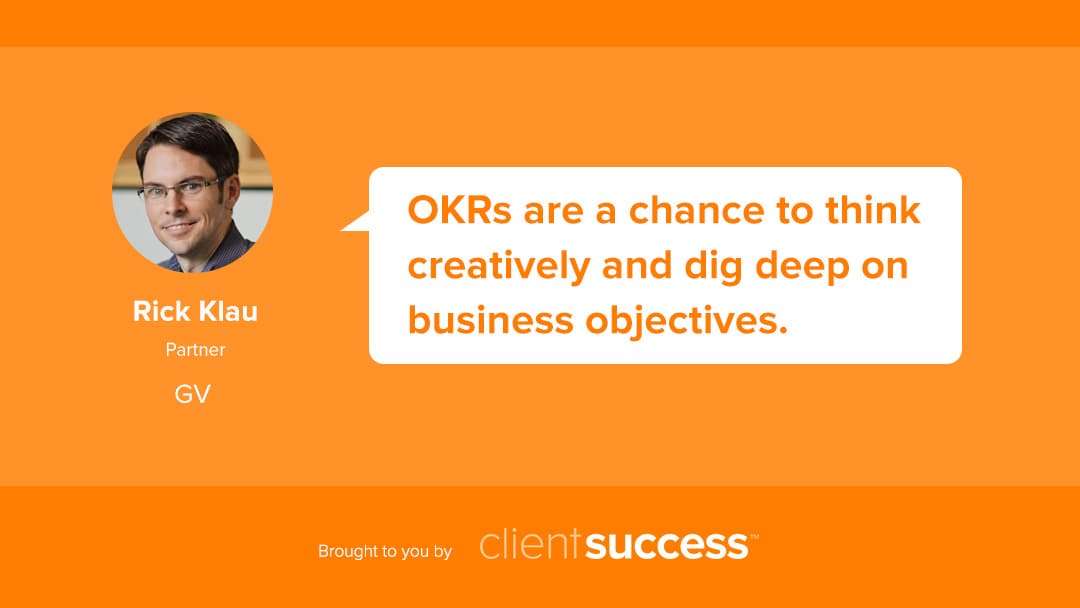
Klau hits on this point multiple times throughout the presentation: “OKRs are not meant to be easy. In fact, if you’re certain you’ll hit your OKR goals, then you’re probably not thinking broadly enough. OKRs are a chance to think creatively and dig deep on business objectives.”

What Makes OKRs Effective?
The standard flow of company objectives goes something like this: Company Goals > Department Goals > Group Goals > Individual Goals. A company looking to stay on task should make sure all individual goals roll up under these other goal segments to ensure the entire organization is aligned from the top down, and the bottom up. And this roll-up strategy is a key part of achieving OKRs.
“This process will fail if everyone in the company doesn’t have visibility into what everyone else is working on,” Klau said in his presentation. OKRs are meant to be shared and presented publicly, from the company to the individual, to ensure accountability at every level.
Even at Google, now one of the largest employers in the world, company, team, and individual goals are public knowledge. The grades and results of these OKRs are also public. It’s important to be able to go back and see what worked, where processes fell short, and what needs to be reworked in the future.
**OKRs and Customer Success **
So how can this goal-setting theory relate to growing customer success teams and organizations alike? It’s important to have your department's goals aligned with the goals of your entire organization. Knowing the OKRs of your company and your department will help determine the goals of teams and individuals.
This goal setting strategy can also help make sure your Customer Success goals are reflected in the goals of the organization as a whole. Customer success, retention, and upsells should be a standard part of any company culture, and having measurable public customer success OKRs can keep everyone on the same page.
For customer success leaders and CSMsl, staying committed to team OKRs can help set measurable goals and ensure they are met in turn. Whether these goals revolve around issue resolution times, retention numbers, or upsell revenue, OKRs keep Customer Success teams accountable to themselves and to their company as a whole. Learn more about industry-leading processes in this webinar.
Stay On Top Of Critical Goals
OKRs are a great way to stay on top of critical goals—and the success of companies like Google shows that they are definitely up to the task. Klau’s presentation reinforced the notion of measurable, accountable goals for an entire organization. Customer Success teams should take these OKRs to heart when determining department, team, and individual goals.
Check out our resources below for more customer success best practices and insights for how your organization can approach customer success with the customer at the center:
eBooks:
Customer Success as a Culture: Customer Success Leaders Edition
Blog Posts:
Popular Compensation Plans for CSMs
How to Build a SaaS Unicorn with Customer Success at the Core
The Customer Success Framework: Relationships, Risks, Revenue
Learn more about how ClientSuccess can help your company develop a strong customer success methodology and strategy with easy-to-use customer success software by requesting a 30-minute demo.


Frequently Asked Questions
What are OKRs?
How do you align OKRs to customer success?
See how ClientSuccess scales the playbook you've built.
Walk through it with a CS-led demo and see how it'd fit your team.