
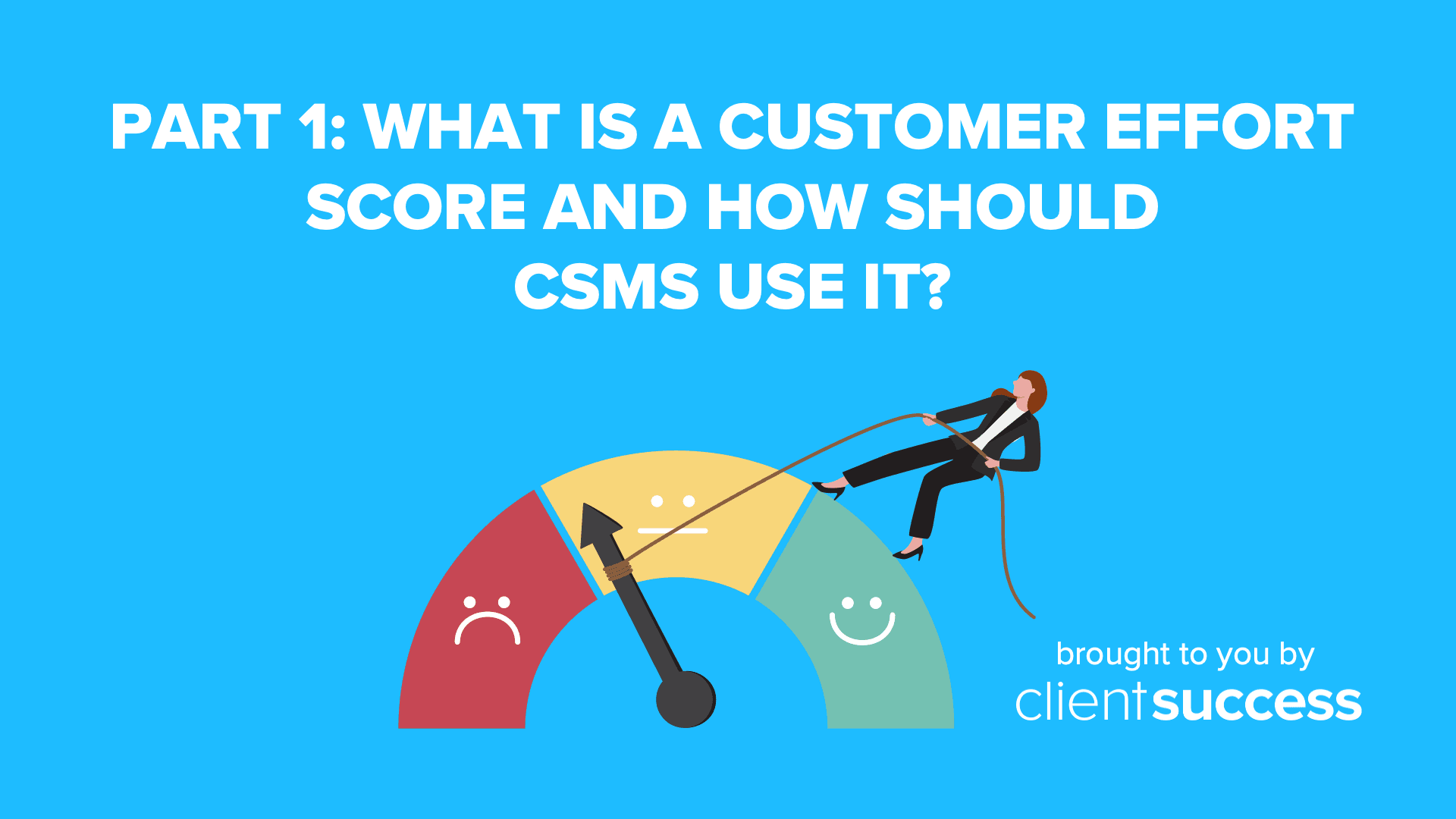
Part 1: What is a Customer Effort Score and How Should CSMs Use It?
A Customer Effort Score measures how much effort a customer spends doing business with you. Learn what CES is, how to calculate it, and how CSMs should use it.
TL;DR
- A Customer Effort Score (CES) calculates how much effort a customer has to put in to do business with your organization — from getting questions answered to working through a renewal.
- The easiest way to measure CES is to ask customers directly how hard it was to get a task done, supplemented by time-to-resolution, number of touchpoints, and level of frustration.
- CSMs should use CES as an internal barometer of their own success — identifying what stands in the way when business is hard for customers — not as a complete picture of satisfaction.
As a customer success professional, you work with scores daily. From NPS to customer satisfaction to customer health scores, you probably know how to calculate many, many complex data points into an easy-to-use score. Are you ready to add one more to your arsenal?
What is a Customer Effort Score
The Customer Effort Score is precisely what it sounds like: it calculates the amount of effort a customer has to put in to do business with your organization. What ‘doing business’ means, however, can be different from team to team. For some, the Customer Effort Score can calculate how much effort a customer has to put in to get questions answered, get issues resolved, work through any platform problems, etc. For some, customer effort refers to more business-focused processes like working through a renewal or expansion, submitting a product enhancement request, and more.
How to calculate a Customer Effort Score
A Customer Effort Score, like most customer success metrics, involves multiple different data points. One of the easiest ways to measure customer effort is to simply ask. Asking your customers, “how hard was it to get {x project or goal} done?” can give you a good gauge of where they understand their effort to be. In addition to this primary metric, however, here are a few additional data points to take into account:
-
The time it takes to achieve a business objective or resolve an issue or case.
-
The number of touchpoints it takes for a customer to have a question answered or to schedule a meeting with an internal resource.
-
The level of frustration (if any) a customer has with your team’s response times, their time spent on upkeep or input, etc.
How to use a Customer Effort Score
So how should you use a Customer Effort Score? Customer effort is a great way to gauge how happy or satisfied a customer may be with your team, but it doesn’t show the whole picture. Instead, you should use a Customer Effort Score to measure the success of your internal customer success efforts. What is standing in the way if it’s not easy for a customer to work through renewal conversations? If a customer cannot get in contact with a resource to resolve an issue, why is nobody available to help them? Using this score as an internal barometer for success can help ensure your team is operating at the highest level and that all internal stakeholders are held accountable for their responsibilities.
Want to learn more?
You can learn more about optimizing your customer experience and leveraging a Customer Effort Score with these additional resources from ClietSuccess:

Frequently Asked Questions
What is a Customer Effort Score?
How do you calculate a Customer Effort Score?
How should CSMs use a Customer Effort Score?
See how ClientSuccess scales the playbook you've built.
Walk through it with a CS-led demo and see how it'd fit your team.