
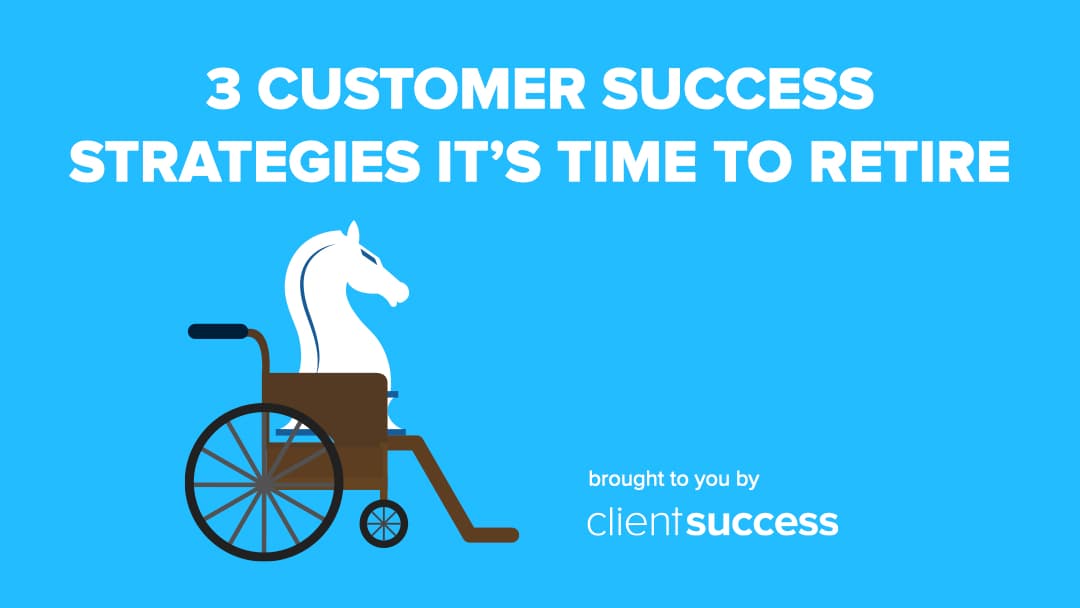
3 Customer Success Strategies It’s Time to Retire
Three customer success strategies it's time to retire: skipping the journey map, juggling multiple metrics tools, and making decisions without data behind them.
TL;DR
- Stop skipping the customer journey map: mapping onboarding, adoption, growth, and renewal helps CSMs see where to take customers and which KPIs to hit.
- Stop monitoring success across multiple disconnected platforms; a single source of truth lets teams gauge account health at a glance instead of comparing scattered metrics.
- Stop making decisions without data—look at where data and customer needs intersect, and let that drive the strategy.
The new year is a time to take stock of the past twelve months, determine what worked well, and identify areas that need a bit of improvement. For many in customer success and account management, 2020 ended up being a year that many of us would like nothing more than to forget and move on from. But, looking back over the past year, the challenges we faced actually can help us move forward in a more strategic manner.
One of the few silver linings from 2020 is that, whether we liked it or not, the processes and procedures customer success managers use every single day came under swift scrutiny, as the entire industry had to pivot at a rapid pace to meet the demands of a challenging year. Some strategies that were long considered inherent or foundational to customer satisfaction and platform success were identified as outdated or underperforming, while other out-of-the-box ideas that had been passed over were re-examined as potential successes.
Here are three customer success strategies it’s time to retire in 2021:
1. Not relying on a customer journey map from the get-go.
While much of a CSM’s focus is initially on customer onboarding, the long-term success and value of an account happens throughout their entire lifecycle. If you’re not mapping out the entire customer journey from onboarding to adoption to growth to renewal, it’s time to start. This can help CSMs visualize where they need to take customers, what key KPIs need to be hit, and where to start introducing new concepts or product features for growth.
2. Using multiple platforms to monitor and measure customer success.
There are plenty of metrics used to determine the ‘success’ of a customer account. NPS score, customer sentiment, adoption rates – they’re all important for a CSM to have a full picture of customer health. So why would you want to access these different metrics from different places? Finding a single source of truth for all of this data means your team can determine and gauge account health with a single glance instead of having to compare and contrast different metrics and scales.
3. Not making data-backed decisions.
2020 saw some wild pivots from customer success teams of all shapes and sizes, and it will be interesting to see how decision-making pans out over the upcoming year. The key to making the right decisions will be data: looking at where the data and customer needs intersect and then grow from there. While your team should be flexible enough to make things work when they need to, it should also be clear that data is the name of the game.
Your new 2021 customer success strategy
While the past year gave you some time to think and reassess your customer success strategy, 2021 will be the year to put these new ideas into action.
Whether you’re starting from scratch or trying to pivot your current processes to meet your new customer success strategy, ClientSuccess can help. Our team of experts is on hand to ensure your 2021 customer success strategy is in line with your goals. You can learn more here.
Frequently Asked Questions
Which customer success strategies should you retire?
Why use a single source of truth for customer success metrics?
See how ClientSuccess scales the playbook you've built.
Walk through it with a CS-led demo and see how it'd fit your team.