
When is the Right Time to Grow Your Customer Success Team?
When is the right time to grow your customer success team? Use three metrics: ACV per CSM, product complexity, and customer volume (aim for 25-30 accounts).

TL;DR
- Three metrics signal when to grow your customer success team: annual contract value (ACV) per CSM, product complexity, and the volume of customers per CSM.
- As a rule of thumb, each CSM can manage about $2 million in ACV and should not be assigned more than 50 accounts, with 25-30 accounts per CSM being ideal.
- The more complex the product and the higher the ACV per account, the fewer customers a CSM can manage effectively; warning signs to hire include shallow relationships, overworked CSMs, and rising churn.
As the growth of your business accelerates, you may face a difficult decision: when and how to scale up your customer success team. Scaling up at the right time with the right approach ensures that customers get the support they need while reducing burnout in your organization. This blog post will discuss three metrics to consider when evaluating your customer success team size.
- Annual Contract Value (ACV) Target Per CSM
- Product Complexity (Simple to Complex)
- The volume of Customers Per CSM
Annual Contract Value (ACV) Target Per CSM
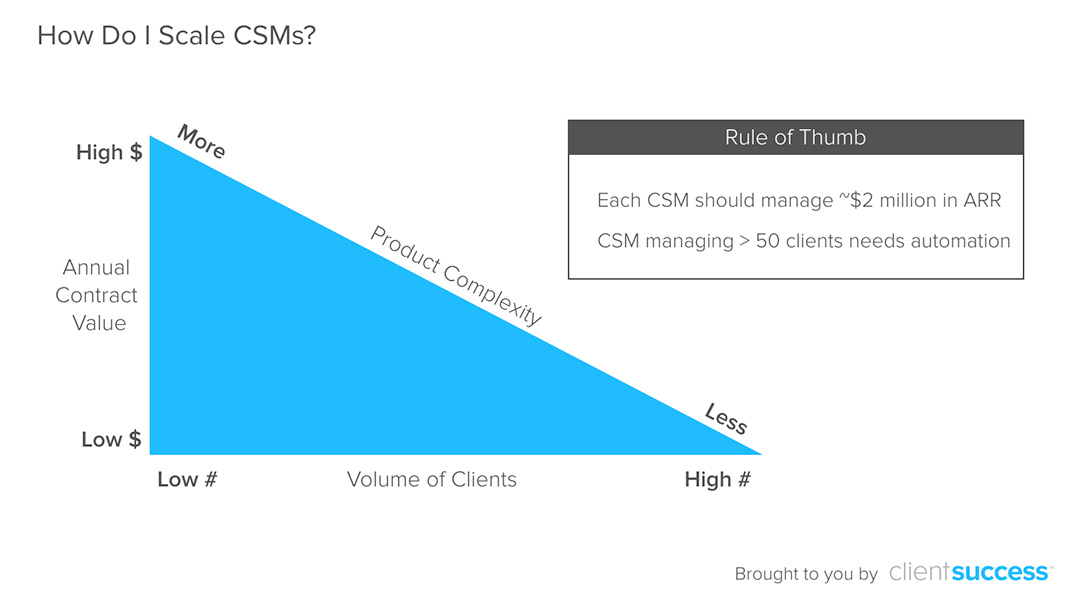
Annual Contract Value (ACV) is the sum of all customer revenue throughout their contract period. As a general industry rule of thumb, each CSM should be able to manage about $2 million in ACV (some may base it on ARR). Generally speaking, the more ACV per CSM, the fewer customers they will be able to manage effectively over the course of a year. Setting realistic ACV targets to ensure each CSM can devote enough time and attention to their accounts is essential.
Product Complexity (Simple to Complex)
The complexity of your product also affects the number of customers each CSM can manage effectively. The simpler the product is to set up, learn, and use, the more customer accounts the CSM can manage.
For example, suppose you have an enterprise-level product that requires extensive onboarding and training for new customers. In that case, your CSMs will need to spend considerable time on each account. On the other hand, if your product is designed for a user to use with little or no instruction, then the time requirements for CSMs by a client are significantly reduced.
The Volume of Customers Per CSM
The third element to consider is the volume of customers each CSM can manage effectively. This will depend on the experience of your CSM, the stage of your SaaS business, etc. But a good rule of thumb is to not assign over 50 accounts. Even more ideal is to set 25-30 accounts per CSM.
The volume of customers per CSM can be increased through helpful technology and automation. Building software (technology) that makes this easy to do is our passion at ClientSuccess.
Below is a visual representation of how these three factors interact.
Bringing the Three Factors Together (ARR, Complexity, and Volume)
Combining ARR, complexity, and volume will help you identify the triggers when it is time to hire additional CSMs. A best practice is to define each of the three factors in your organization clearly. Depending on where you are in your growth trajectory and what growth channels you are pursuing, you may need to consider different scaling scenarios that prioritize growth differently. Natural indicators that your model needs refinement include shallow customer relationships, overworked CSMs, lack of insights and knowing the true pulse of your customer base, and an increase in customer churn.
Now that you understand the three factors, you can set thresholds or review points for each. For example, you'll see that you're trending towards 75 customer accounts for a single CSM by the end of the next quarter. Then, it's time to start interviewing and budgeting for a new hire immediately – or have a few strong candidates in the pipeline.
Check out our resources below for more customer success best practices and insights for how your organization can build strong customer relationships:
eBooks:
5 Ways to Surprise & Delight Your Customers
3 Steps to Putting Customers First
Blog Posts:
6 Listening Techniques of Great Customer Success Leaders
3 Simple Strategies to Build Strong Customer Relationship ROI



Frequently Asked Questions
When should you grow your customer success team?
How many accounts should a CSM manage?
How much ACV should one CSM manage?
See how ClientSuccess scales the playbook you've built.
Walk through it with a CS-led demo and see how it'd fit your team.