
Customer Success as a Culture — How Degreed Uses Empathy to Create Amazing Customer Success
How Degreed's Kat Archibald uses listening, a customer advisory board, and empathy to find the real problem behind customer requests and build better tools.
TL;DR
- Degreed's Kat Archibald advises product and CS leaders not to build the solutions customers suggest right away, but to dig for the underlying problem first.
- Understanding the customer's real problem creates empathy, and empathy is what leads to better design and products.
- Degreed runs a Customer Advisory Board of about 12 clients, chosen for a mix of company size and industry, to validate ideas early before anything goes to development.
- Archibald listens first instead of leading with questions, building relationships of trust so customers bring their problems to her team.
To succeed with customer success at your organization, it takes incredible alignment and collaboration with your product team. We interviewed and asked 8 industry leading product leaders their advice on how they put customers first when building new products or working on existing products at their particular companies. Today we’ll highlight Kat Archibald, VP of Product at Degreed. In this post, we’ll briefly explore her approach to customer success alignment as it relates to the product team at Degreed.
Download a complimentary copy of the eBook “Customer Success as a Culture: Product Leaders Edition” to see Kat’s full contribution and get access to other product leaders’ viewpoints.
About Degreed
Founded in 2012 and with offices in San Francisco and Salt Lake City, Degreed exists to discover, empower, and recognize the next generation of the world's expertise. Degreed is an education tech company that is engaged in the measurement, tracking, and validation of all the learning individuals do throughout their lives. **
**
The Role of Product at Degreed
As Head of Product for Degreed, Kat is responsible for 3 major areas:
- Execution of company strategy and mission as it relates to product
- Team development (recruiting, training, coaching
- Providing context and ensuring product alignment
Kat takes her role very seriously and one of her top priorities is customer success. She explained that in order to keep customers a top priority for product development, she’s on the phone with customers on a daily basis. She also works closely with Degreed’s VP of Client Success to ensure that the product is always anticipating and solving for customer problems. When it comes to making product decisions, Kat and her team listen closely to their customers to identify problems that need to be solved. “They [customers] often speak in solutions, and it is up to my team and me to take those solutions, hear the problem behind them, and then solve it in a much better way then they could have came up with on their own.” explained Kat.
Listen First to Establish Relationships of Trust
Instead of asking customers questions about how they engage with Degreed’s product, she does her best to just listen. By engaging with them early and often, she’s able to establish a relationship of trust. They know they can go to Kat and her team with their problems and they will work hard to solve for them, she explained.
One major way Kat is able to gather data points and commentary from customers is through Degreed’s Customer Advisory Board. “We currently have about 12 clients on our Customer Advisory Board. We work to have a mix across company size, industry, etc. So they’re chosen by 1. Willingness and 2. Demographics,” said Kat. “We listen to their problems and we work closely with them during the discovery process to ensure that they’re seeing proposed solutions early and often,” said Kat. “I love our Customer Advisory Board because it enables us to show them our ideas and to quickly get validation before anything ever goes to development.”
Kat’s Advice: Find the Core Problem First
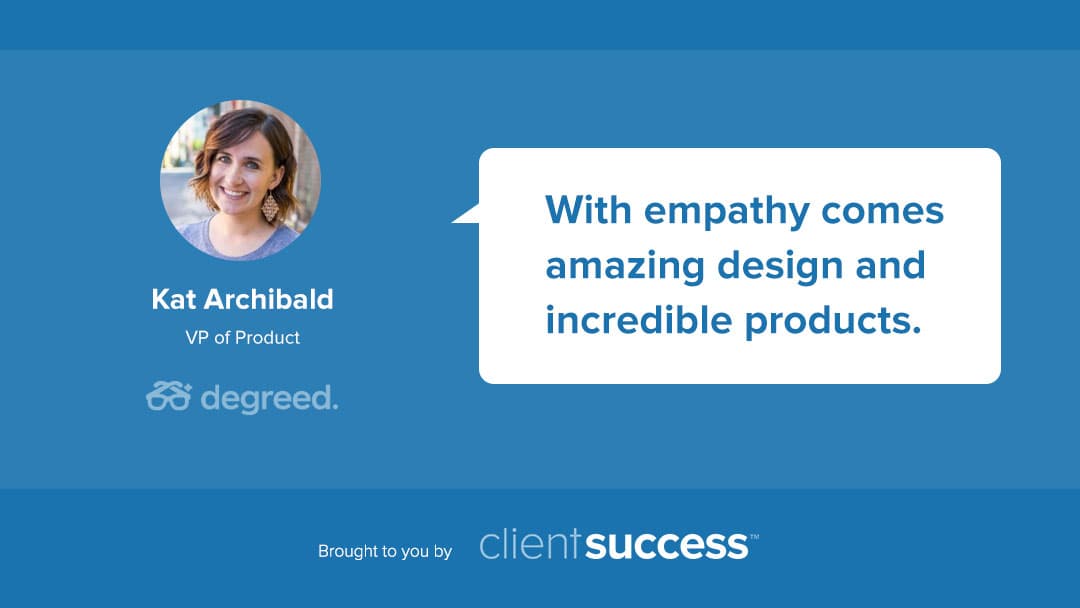
Kat has some great advice for fellow product and customer success leaders: “Don’t implement the solutions customers suggest right away. Rather, drive to hear the problem that is inciting that solution. Once you can understand their problem, you can find empathy. And with empathy comes amazing design and incredible products.”
Read Kat’s full contribution to the ebook entitled, “Customer Success as a Culture: Product Leaders Edition” and learn from 7 other product leaders like Joanna.
Download the full “Customer Success as a Culture” ebook collection:
Customer Success as a Culture: Sales Leaders Edition
Customer Success as a Culture: Marketing Leaders Edition
Learn more about how ClientSuccess can help your company develop a strong customer success methodology and strategy with easy-to-use customer success software by requesting a 30-minute demo.

Frequently Asked Questions
How does empathy improve customer success and product decisions?
Why shouldn't you build the exact solution a customer asks for?
How does Degreed use a customer advisory board?
See how ClientSuccess scales the playbook you've built.
Walk through it with a CS-led demo and see how it'd fit your team.