
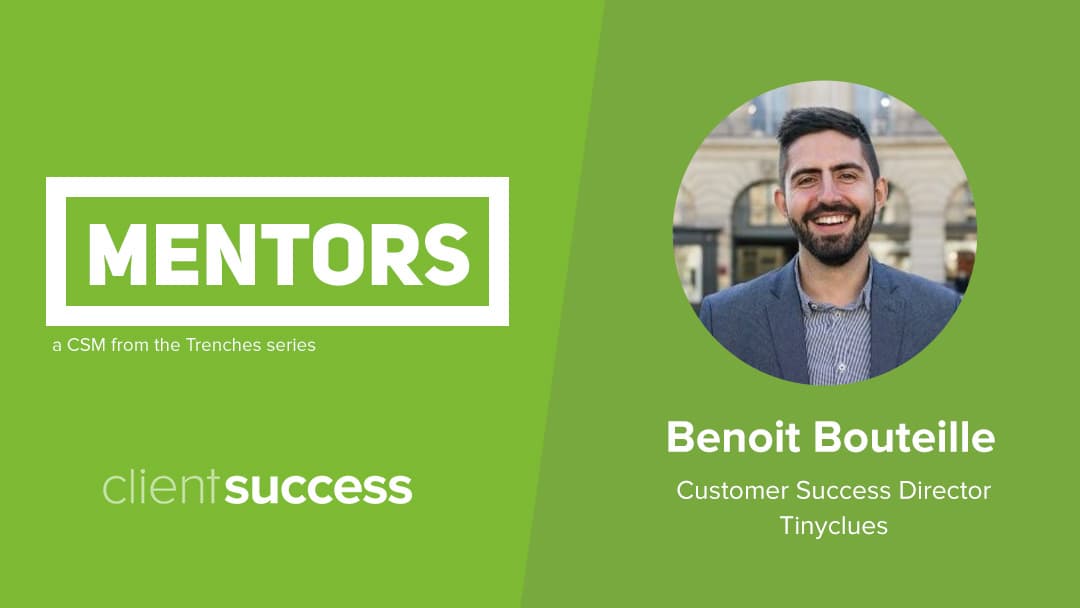
CSM from the Trenches: Mentors – Benoit Bouteille, Customer Success Director, Tinyclues
Tinyclues CS Director Benoit Bouteille on managing expectations after fast wins, defining success criteria early, and why proven value drives every renewal.
TL;DR
- Benoit Bouteille warns that delivering excellent results too quickly can backfire if expectations aren't managed, since customers may set unrealistic terms for the next time-to-value.
- His core advice is to define clear success criteria with the client early, because a clear goal makes the path to success easier to build and follow.
- Bouteille uses a daily team stand-up to share knowledge, letting CSMs explain situations they face and ask for help so clients get consistent quality regardless of who is assigned.
Welcome to our blog series CSM from the Trenches, a community for frontline Customer Success Managers (CSMs) that discusses trends, best practices, and advice for the frontline.
Being on the CSM frontline allows us to directly influence the success of our clients. I love that; as our clients are successful, we’re successful. Each day we learn from the trenches what it takes to make clients happy and successful.
Mentor Questions
This segment of the series focuses on 7 mentor questions for the frontline. The goal is that by sharing our experiences we’ll be able to learn and apply more practical advice / practices to our careers.
Let’s get started with this week’s post!
From: Benoit Bouteille, Customer Success Director
Company: Tinyclues**
Location**: Paris, France
Question 1
What is one customer success best practice you’ve applied in the last few months that has had a positive impact on your success in your role? How has it helped you?
As Customer Success Director, I'm tasked with helping the Tinyclues CSM team do their best job possible, as well as ensure each of our clients are provided with the same quality of experience regardless of who the assigned CSM may be.
This can be challenging in the context of high-touch customer success practices and a fast growing team, so one effective practice we follow is sharing knowledge during our daily stand-up. Here each CSM has the opportunity to explain situations they’re facing and how they're managing them, as well as ask for help and advice from other members of our team.
This morning routine has created a great sense of team spirit where rookies and experienced CSMs work together.
Question 2
What are one or two things you typically do during the first hour of your day that leads to a productive day?
First thing I do in the morning (after checking last night MLB's results) is check my to-do list, calendar, and inbox to be sure items are well-prioritized. Topics in need of immediate attention are on top of the list, but I also give specific attention to topics coming from our offices overseas.
With a team and clients who work in different timezones, it's important to optimize things to ensure they'll have a reply first thing according to their timezone.
Question 3
What are one to three books, blogs, or thought leaders that have greatly influenced your career, and why?
Customer Success: How Innovative Companies Are Reducing Churn and Growing Recurring Revenue is a great all-you-need-to-know read when it comes to CSM best practices as it covers a variety of topics and the authors always provide tips to sharpen your skills. This book also helped me improve internal communication and evangelization around CSM practices within our company.
Question 4
How has a failure, or apparent failure, during your time as a CSM set you up for later success? Do you have a “favorite failure”?
The apparent failure I'd like to share might come across as unconventional, but I ask for your patience as I explain myself. I’ve learned that reaching excellent results too quickly may be something to be cautious about in the best interest of a partnership. You’re probably wondering "How can reaching great results too quickly be a failure?". The key is to continually and properly manage expectations.
The pre-sales and onboarding phases set up initial expectations for the client, and as customer success professionals we try to help clients achieve their objectives as quickly as possible and with the greatest impact. Personally, I've experienced that (if we are not careful with expectation management) this can result in clients setting new (and potentially unrealistic) expectations for themselves about the relationship. In these situations after achieving a rather quick and meaningful first time-to-value, I’ve unknowingly put myself at the mercy of the client where I’ve needed to quickly generate additional value according to their unrealistic terms. While I’ve been able to deliver, it's usually been with a smaller lift than the results of the first time-to-value.
Some clients can become disappointed when their second time-to-value does not happen as quickly as their first, simply because their expectations were not properly set. That disappointment can then take two or three meetings to help clients understand the global value that’s been generated (the 1st great one + 2nd good one).
All this is to say that client expectations can sometimes be set unrealistically high if we don't properly manage them. It's really important to continually define success criteria and when you reach them, celebrate and set expectations for the next time-to-value. Make it count! Always focus on generating additional value by showing the positive impact of your solution/platform.
Question 5
What do you find most fulfilling about being a CSM?
As a former E-commerce Marketing Director, the most fulfilling thing about being a Customer Success Director in a Martech company is to work with and help companies improve their strategies.
I also enjoy working with my team; they’re like a hub of best-in-class CRM strategists with the objective to help our clients reach their goals in the best way possible.
Being in the center of all this is really exciting because we contribute to sharpening best practices for the entire CRM industry. Ultimately, being a CSM in this space is most fulfilling because we’re able to improve the end-user experience.
Question 6
If you had to give one piece of advice to another CSM, what would you say and why?
My one piece of advice to a CSM would be to focus on defining success criteria with the client because as soon as you have a clear goal or direction, it's easier to build and follow the path to reach the success. If it’s not clear from the beginning, there’s higher risk of losing value along the way.
Question 7
What is one customer success principle you try to live by?
Focus on generating and showing the value added by your service or platform. Just because a client says they're happy doesn't mean they'll keep renewing. At the end of the day, relationships won't last if there is not enough value generated customer.
——————————————————————————————————–
Want to share your mentor advice? Submit your answers here.
——————————————————————————————————–
Here are other customer success resources:
Customer Success eBooks:
Customer Success as a Culture: Customer Success Leaders Edition
Ultimate Guide to SaaS Customer Success Metrics
Other CSM from the Trenches Posts:
Sam Feil, ClientSuccess – 11 Books Frontline Customer Success Managers Should Read Right Now
Cole Sanders, ClientSuccess – 3 Principles I Learned in My First Year as a CSM
Mieke Maes – 5 Keys to an Effective Customer Apology
Learn more about how ClientSuccess can help your company develop a strong customer success methodology and strategy with easy-to-use customer success software by requesting a 30-minute demo.


Frequently Asked Questions
Can delivering customer results too quickly be a problem?
What is Benoit Bouteille's top advice for CSMs?
How can a customer success team deliver consistent quality?
See how ClientSuccess scales the playbook you've built.
Walk through it with a CS-led demo and see how it'd fit your team.